
Amid all the Call of Duty games, Battlefield scrums, and every first-person shooter in between, it should never be forgotten where the blueprint for these came from. Knowing your gaming history will allow you to appreciate your gaming present. One might even say that by understanding the progression in the past, you will avoid being Doom’d to repeat it.
Or something clever like that.
For those of us who experienced the original gaming pair the first time around, they were a marvel to behold, as they pushed constant progression of the first-person shooter genre. After Wolfenstein 3D kicked off the FPS mania, Doom pushed it forward, and by the time these games were built on the Doom Engine, the devs had figured out what tiny gameplay elements were missing. And it should be noted that we all take steps forward for granted.
Heretic and Hexen made progressions and improvements with simple things like having the ability to use the entire 360-degree space that the 3D worlds they held provided. Having the ability to hold multiple weapons, from melee to gun-like, was a push forward. Even the simple mechanics of jumping changed the way these games were played and perceived. All of this was the original groundwork for modern FPS games, and love them or hate them, you must respect the effort, and Nightdive Studios did a great job of respecting them.
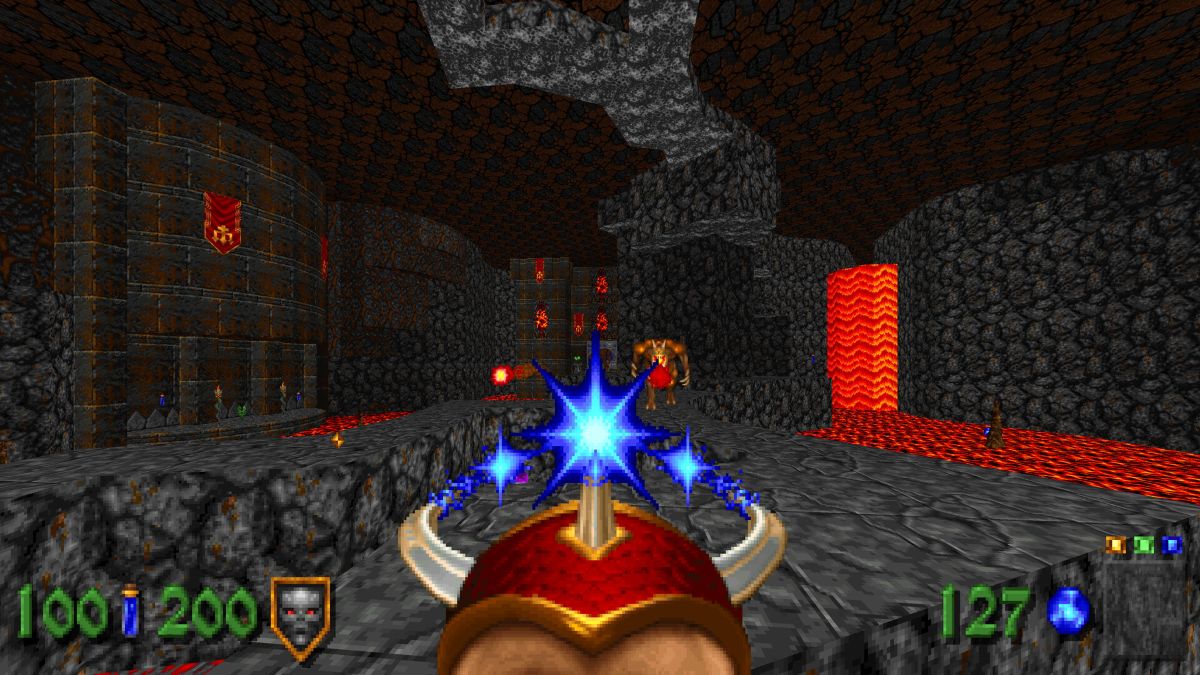
Anyway, 30+ years after being released, Heretic + Hexen have returned for modern-day consoles, courtesy of Nightdive Studios and publisher Bethesda Softworks. So, what did Nightdive Studios deliver with Heretic + Hexen? Well, they brought modern-day improvements to old-school gaming. This meant that the pair of games has been tweaked and perfected with controls that work well on the present-day controllers. That’s the first big improvement for me.
The time I spent with the games showed the smooth transition from mouse/keyboard to PlayStation DualSense. Nothing feels clunky, and none of the games featured in this collection feels out of place. They are perfectly translated from the 90s to the present, which is a big deal considering most classic games don’t get this sort of treatment. For me, that was a huge deal, as I generally stay away from clunky clankers that carry old-day control schemes. They are generally uncomfortable to play.
In addition, the frame rates have been cleaned up, as have the graphics, though they still maintain the pixelated hellscape that was the 90s FPS experience. The visual improvements are there to conform to your expectations of how these games should act in a modern-day setting. Again, the actual graphical style is still intact, but colors and small visual improvements have been added to make this experience a little more delightful.
And this is just the tip of the iceberg.
The game also features the entire collection of titles in both series. They are as follows:
- Heretic: Shadow of the Serpent Riders
- Hexen: Beyond Heretic
- Hexen: Deathkings of the Dark Citadel
- Heretic: Faith Renewed
- Hexen: Vestiges of Grandeur
The collection won’t feel short and uninspired, especially the last two on that list, which are completely brand new and work well. Now, having said that, the games will look and feel the same, even though they are different. The visuals perpetuate the lack of variety, which is a common notion when playing 90s FPS games like this. For example, Doom and Doom II always had a sense of similarity in their construct, even down to the enemies. There were reasons for this, mainly because the devs were still trying to squeeze what they could figure out from the Doom Engine. Levels still look similar in the original games, and even the new ones, as there weren’t major improvements to textures, worlds, and such. If you have never played Heretic or Hexen in your life, then you’ll get that same sense of similarity from the experience.
But! If you look closely at mechanics and how little things, like the aforementioned jumping ability, improved the gameplay, then you’ll understand the roadmap that each of these titles takes. Even the separate adventures have some good differences between them, as enemies become improved, and the maps are well-designed puzzles with hidden rooms that are tricky to navigate through.
What also improved with Heretic + Hexen with this re-release is the online and co-op options. The game can be played online, up to 16 people at a time, and cross-platform. As much as I would have loved to take on a PC player from my Nintendo 64 online back in the day, it was not a possibility. This modern amenity makes this re-release an easy buy, especially the co-op, which is just primo. For those of us who LAN’d it up back in the day, playing these games from afar is nice.
The way that Nightdive Studios built the online portion of the game made the process a helluva lot smoother. The inclusion of co-op and modes like Team Deathmatch made this re-release more enjoyable. I would have loved to play that in the 90s, but most of us were still on dial-up, praying that no one called to interrupt our online gaming sessions.
Anyhoo, parts of this release that I didn’t expect, but was pleasantly surprised about, were the mods, which are abundant and available on each game, including the new ones. The inclusion of behind-the-scenes materials from Raven Software was also the chef’s kiss on this delight. The BTS gives you access to concept art, character designs, and even textures. While it’s nothing more than a window to look inside the development process, it’s a neat history lesson that shows how each development step progressed as the genre started to get figured out. It’s a nice touch.
Anyway, this re-release was unexpected, but it was respectful of the original material. The online and co-op components make the gameplay a lot deeper, even for 30+ year old games. The inclusion of new content and the open door and contained access to mods make this an even sweeter trip down memory lane.
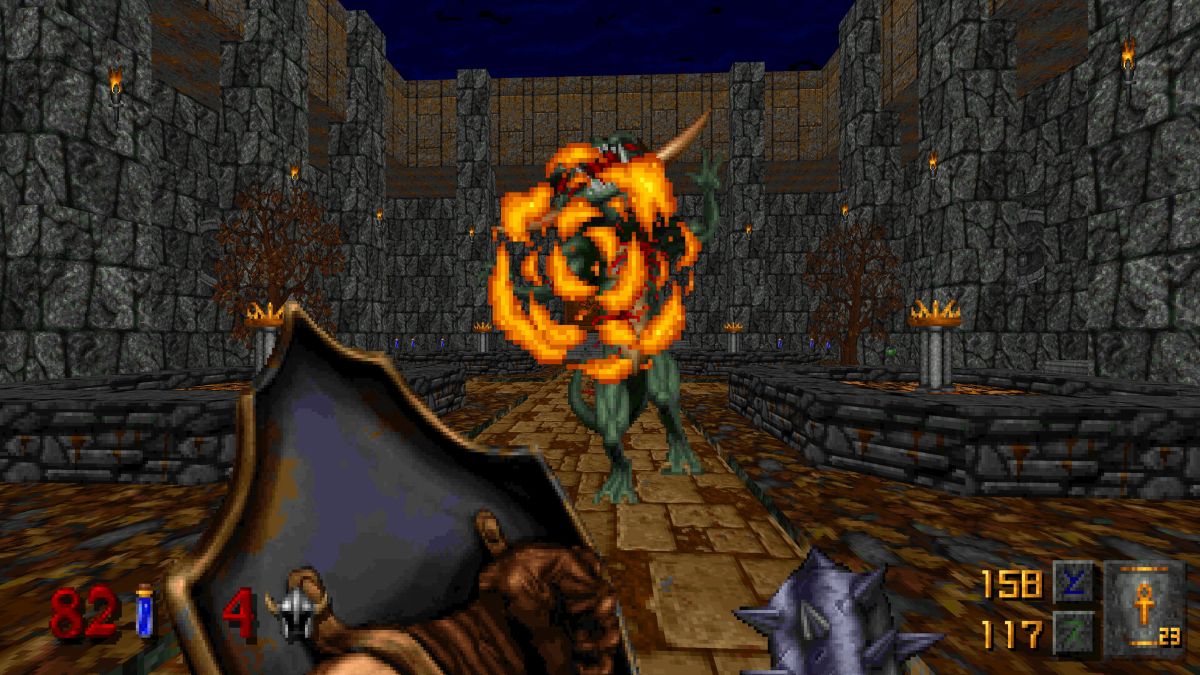
All this said, I realize that not every gamer is going to buy into this nostalgia. I suspect that most will have a hard time dealing with ancient graphics and gameplay limitations that they’re not used to seeing or experiencing. All these things are a fault of this re-release, but at the same time, it’s what needed to be done to capture gaming in its early glory. In other words, this won’t be for everyone. Mainly just us old farts.
On that sweet note, let’s wrap up this review.
Conclusion
Heretic + Hexen brings back a revival of 30+ year old marvels that progressed the first-person shooter genre in the 90s and set the path for future FPS games. The additions of new online modes, direct access to mods, and new content make this even sweeter. But the games do look like they’re from the 90s, which may not be everyone’s cup of tea.