


Godbreakers is packed with smooth, tight action and engaging boss fights that can be invigorating in co-op. But a lack of content outside of blistering difficulty modifiers may be disappointing for roguelike fans.
Godbreakers doesn’t truly get hard until after players beat a complete run for the first time. And as a player relatively well-versed in roguelikes, that’s a surprising twist in the formula.
After felling my first raucous, multi-stage boss I had burned through my limited-use healing coils. A combination of unfamiliarity with a new game, an accidental heal, and a decent difficulty curve showed signs of the type a challenge a player may expect from a title forged in the crucible of Hades and Risk of Rain 2, to name a few.
I died halfway through the second world, battle-weary but adjusting to Godbreakers‘ logic. Immediately pushing into a second run using a different character archetype, I crushed my way to the third world a bit more unscathed but still dangling on the precipice of death. An unwieldy mid-boss had pushed my upgrades and skills to the limit and the edges of the screen blossomed red, an indication of my sapped HP. And, as it tends to be, an unceremonious projectile out of nowhere ended that run.
Pushing so far on my second go with Godbreakers had yielded me a number of cosmetic unlocks, new quests, permanent upgrade currency, and a new archetype. Though its attacks were slow and sweeping, I decided to try out the scythe-wielding form that could spawn damage-dealing sentries and see how much further I could push.
That ultimate victory felt good. Appropriate even. By that time I had understood most of what Godbreakers was offering to me as a player and fan of the genre. I could identify what equipment I thought was best. I smartly recycled unneeded items so I could purchase better stuff at the shop. I had a better sense of enemy attack patterns. And in general, I was simply a bit luckier–a hallmark of successful runs.
But once that final thrilling boss had been felled, I couldn’t help but think that Godbreakers was over before it had even started. Yet I still plunged in.
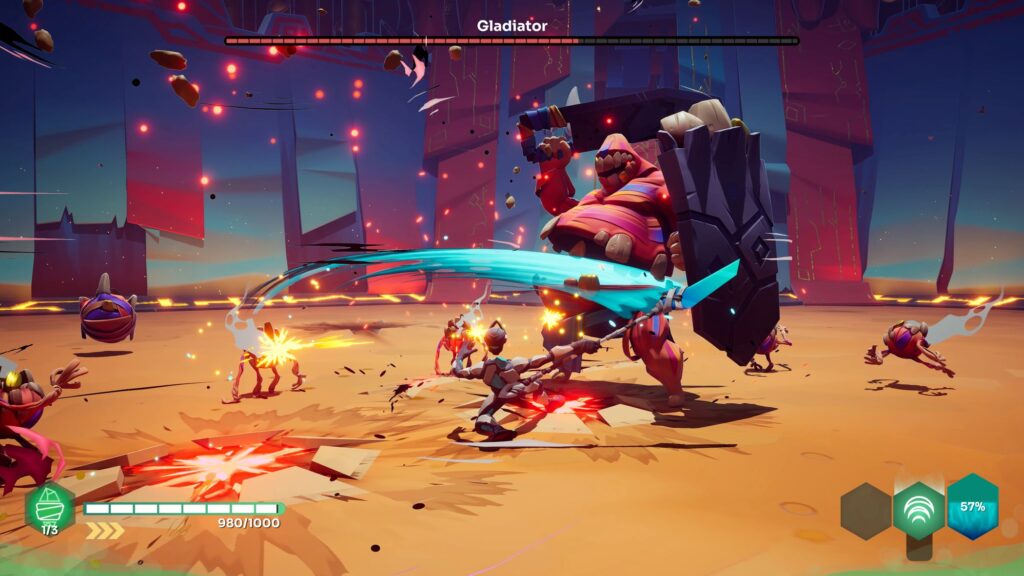
Godbreakers‘ movement and combat is extremely proficient and one of the reasons that “one more run” feeling is so tantalizing here. Developer To the Sky smartly enabled attack and movement cancelling by simply pressing the dash/dodge button. Over my dozen hours across multiple runs, the responsiveness and fluidity of combat kept me engrossed. A primary attack, heavier secondary attack, charged attacks, dash and air strikes, and combos are all given to the player to incorporate into their fighting. Is it possible to spam the primary attack? Yes, it’s quite reliable. But as the edges become sharper, the full suite of movement needs to be considered.
Would fighting have felt clunky, slow, or mediocre, Godbreakers would hobble across a finish line players might feel forced to reach. But coupled with a relatively quick, no-nonsense pace, engaging with multiple runs is an easy task.
To the Sky cuts the fat from nearly every aspect that may provide friction between the player and combat. Godbreakers has a narrative drenched in lore but most of it is tucked behind a hefty codex. At its most basic level, a coven of three seemingly divine beings has tasked the player with killing gods. Primarily a god named the Monad who is trying to absorb the sun in a far-flung future where the creation of AI eventually led to the downfall of man. The gods players kill speak in omniscient tones, all musing on the nature of the Monad and how the player may eventually come to triumph. There’s a concept or two of intrigue and the moments leading up to and after the final confrontation were compelling enough for a game of this type.
Of course after the first ultimate victory, more is required of the player to truly understand what’s going on and that’s when Godbreakers attempts to offer up more to the player and where a crossroads may exist.
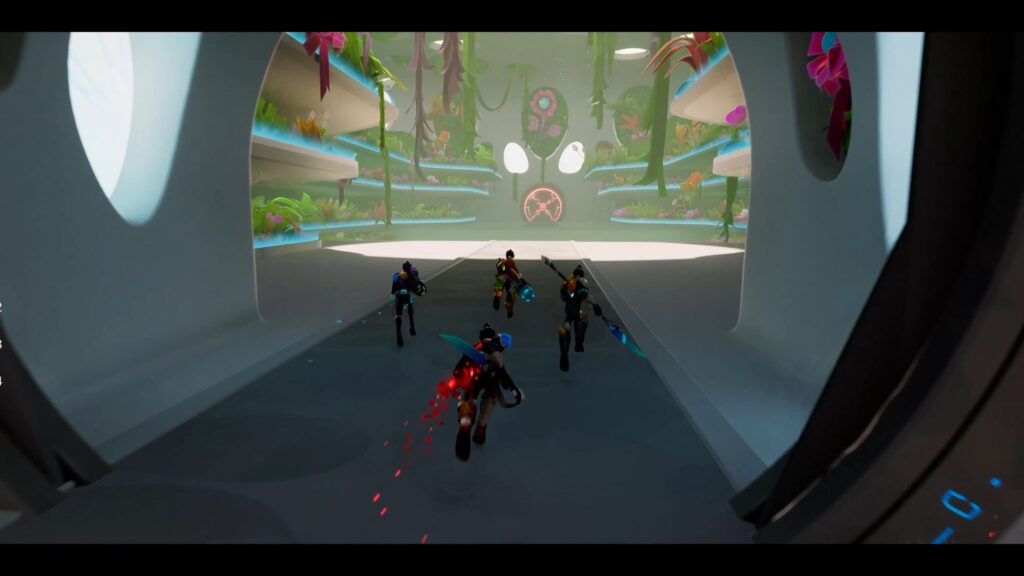
After that third run, I had seen a large portion of what Godbreakers has to offer. Traditionally, a roguelike will push the player to their limits on their first boss attempt. Failure may come a few times, requiring a solid investment in permanent upgrades to feel a palpable sense of renewed strength. But there is a sense that Godbreakers leans more towards sheer skill rather than a constant treadmill of currencies and upgrades.
Still, there are only five levels/biomes/worlds in the game. There is little distraction outside of maybe a hidden chest or lore drop. Players zip from one combat room to the next, fight enemies, fight a mid-boss, fight more enemies, then fight the main boss of the level. A full run without difficulty modifiers can take a little under two hours. And because Godbreakers isn’t rife with content, it means that no matter how good the action is, it can get repetitive.
This is an extremely important caveat to keep in mind primarily because I recognize that large shortcoming but acknowledge how much fun Godbreakers is to play.
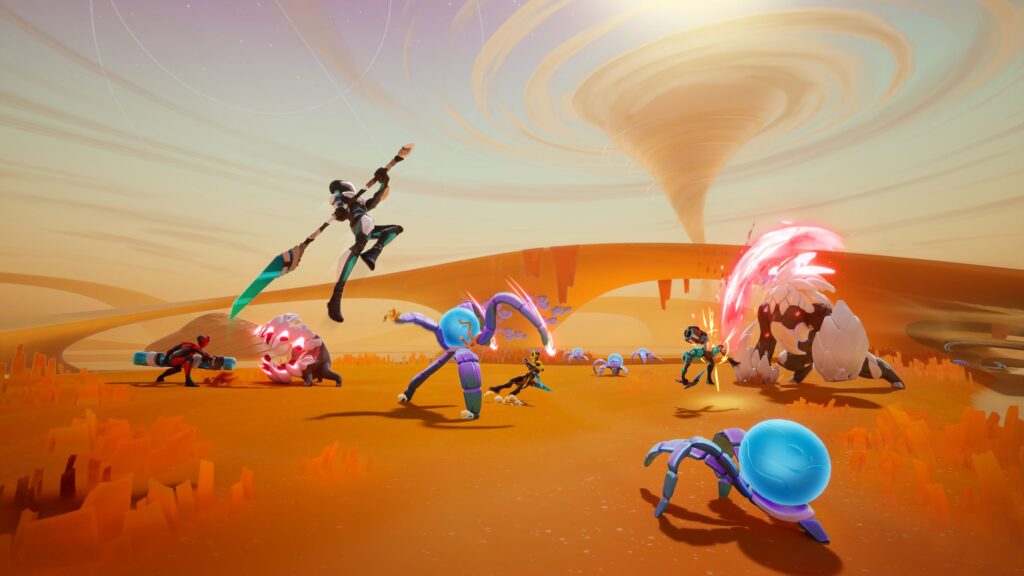
Each run, players can equip pieces of armor–feet, legs, chest, arms, and shoulder–that come with unique modifiers and abilities. Essences are collected that stack benefits for the player and can help increase the viability of equipment. Essences often enable debuffs on enemies like poison or decay that does damage over time, while equipment can increase the damage done by poison or add effects like stun to chain lightning.
There are over a hundred pieces of equipment that players can equip all with varying degrees of rarity that can greatly synergize with not only the character archetypes but essences, making for exciting builds. At the start of the game, players can choose between two archetypes. The Lancer is fast and all-purpose, while the Pillar is heavy-hitting but slow. By completing certain tasks or quests, players also open up a Twin Blade assassin, a gun-toting Duelist, the Reaper, and the melee Striker. Each of these archetypes also has their own unique weapon ability with two additional ones that can be unlocked by doing certain tasks. Additionally, players can unlock cosmetic items through separate feats.
To fuel additional playthrough incentives, players will invest in echos that are earned by felling bosses and playing runs. What is interesting about the way Godbreakers handles permanent upgrades is that none of them are strictly “do more damage” or “have more health”. Instead, players unlock and invest primarily in the luck-based economy of a run. Starting a run with equipment choices, gaining merchant rerolls, and granting a chance to choose fragments and essences are the big choices. Enabling these will allow the player to potentially tailor a run more towards what they hope to achieve, whether it be more defensive buffs or spamming ailments on enemies.
With the Monad defeated, players then unlock “tangles” which are difficulty modifiers that can be applied to a run. Suffice it to say, these modifiers are some of the harder ones I’ve seen in the genre, truly giving players a test of skill. Want direct hits to instantly kill the player and minor enemies? You got it. Reduce healing effectiveness or strip the ability to use a healing coil? Alright. Killing enemies makes nearby enemies stronger and the effect stacks? Yikes.
Godbreakers can become absolutely dastardly with any one or two of these tangles applied, let alone five. And because the permanent upgrades through echos are limited, skill plays a crucial role in being able to tackle these extreme challenges.
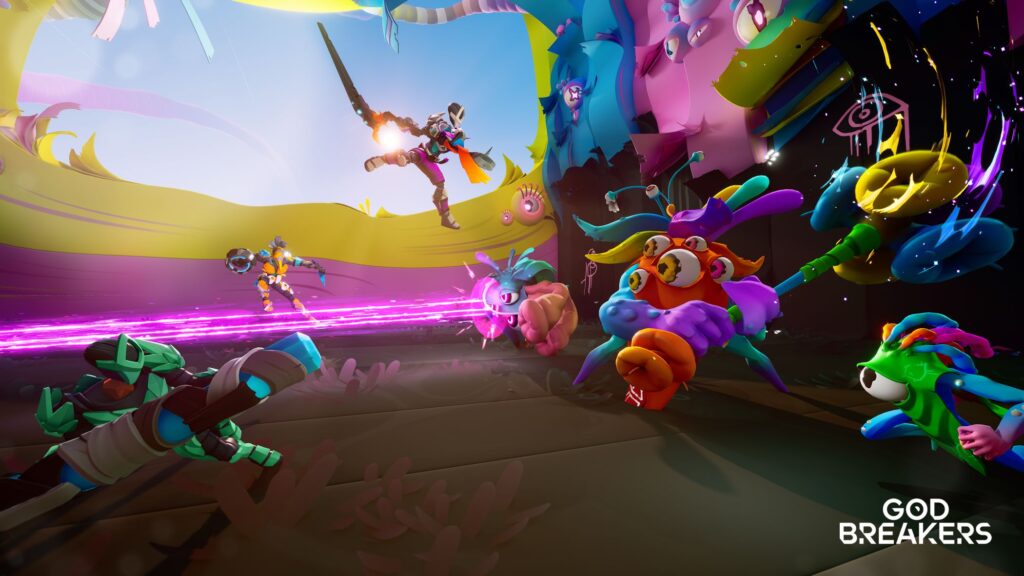
Further incentive exists by quests that become activated in each biome. But many of them are relatively ho-hum. Usually it boils down to killing an enemy with environmental hazards in a specific level or using certain powers. Nothing too exciting but it does unlock more content and future tangles for players to use.
For me, where Godbreakers truly shines is in the ability for up to four players to engage in a run together. However, keep in mind that multiplayer in the game does not have matchmaking. Instead, players need to use a room code to join a friend or stranger currently hosting a session. I understand the rationale behind this method so all players start a run at the beginning rather than trying to randomly apply upgrades and items mid-run.
But if you have a group of friends that wants a thrilling challenge, Godbreakers can provide that in spades. The game does account for multiple players by adding to enemy health pools and adding more enemies to the screen. And despite the constant explosions and fury of things happening on screen, the framerate never suffered on PlayStation 5.
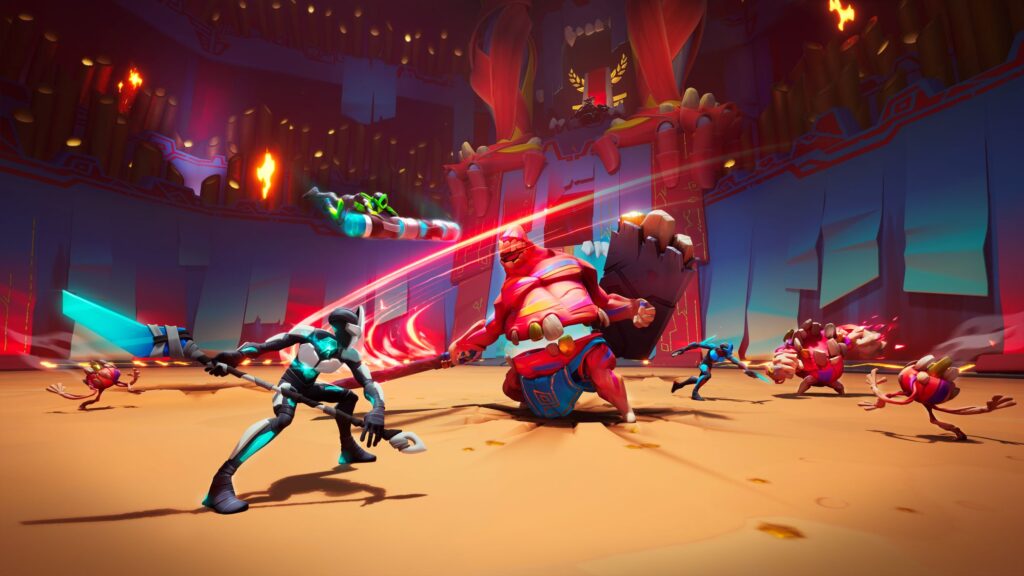
In terms of gameplay, I would argue that co-op potentially makes the game a touch easier. When playing solo, all enemies converge on you. With multiple people, it feels like there is potential to have some breathing room. Unless an ability stuns them, most enemies don’t flinch when hit, meaning that the player can batter them until the last moment before being attacked. But projectiles and other concerns can leave the player running around frantically. With friends, it doesn’t feel so insurmountable.
And in cooperative play, Godbreakers‘ incredible boss fights really take on a new life. All six bosses are kind of spectacles in their own right, having damage phases, trash mobs to worry about, and screen-filling attacks that must be escaped from.
Of course, I would be remiss not to mention the Godbreak ability in Godbreakers. When an enemy or mid-boss has their health reduced enough, players will be able to jump into the body of that enemy and burst out of them with a damaging explosion, stealing the signature attack of that enemy. This ability to Godbreak is a constant factor in fights because players can only trigger it when they hit enemies enough times to charge up a meter. Once it gets to 100 percent, the cue to Godbreak appears on an enemy with low enough health.
These signature abilities are flashy but not always game-changing. Players can rocket punch, trigger buffs, shoot out slowing bubbles, enable a slam that stuns, burrow underground and burst out to damage others, and spit damaging pools of poison. Because of how hectic play can be, it’s not always easy to time a Godbreak but with other players all banking a special, it can be a lovely display of damage, especially against elite enemies.
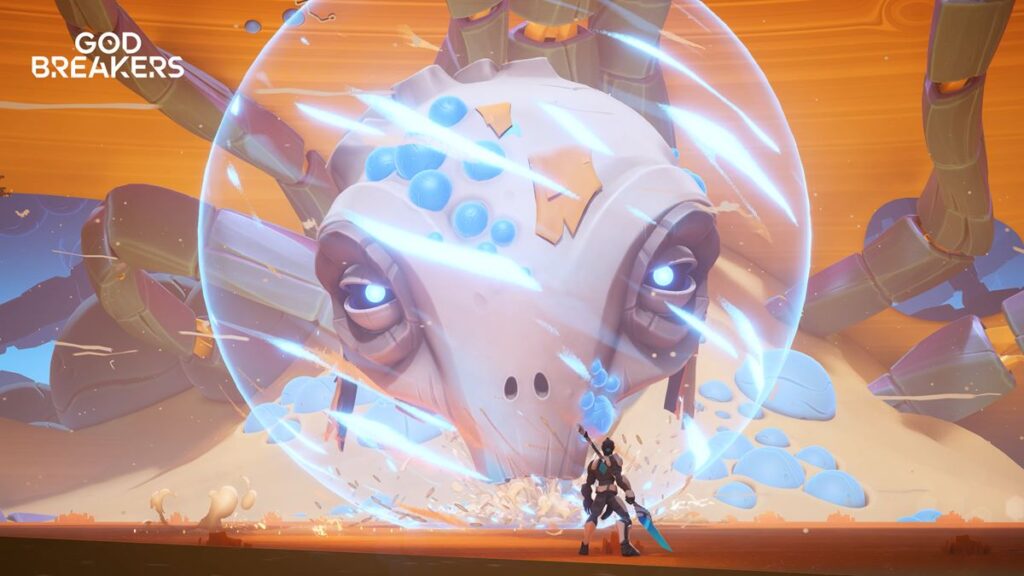
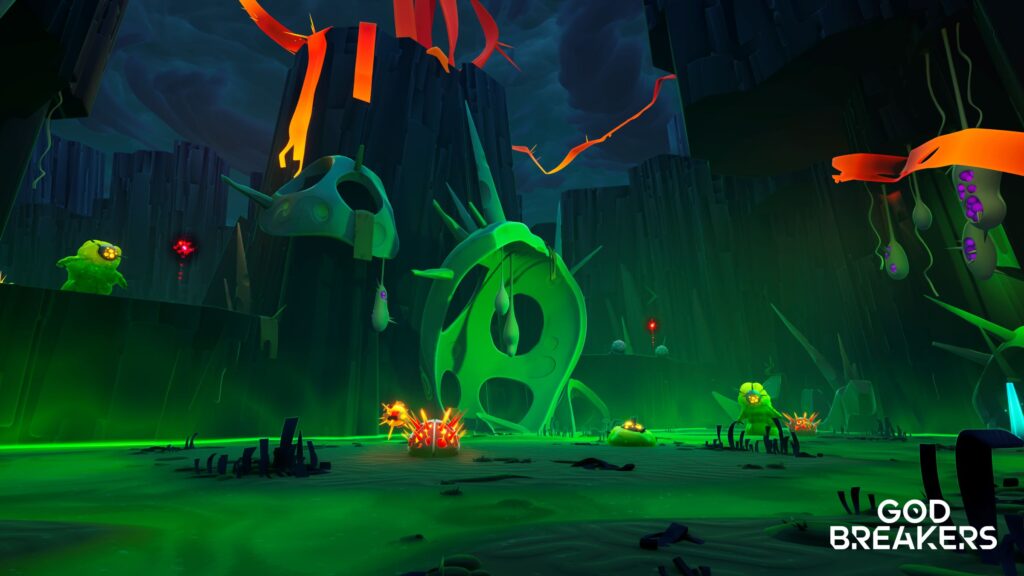
But like with everything in regards to Godbreakers, I simply wish there was more. I want more of these vibrant worlds with their eye-watering bold colors and strange interpretations of classic video game worlds. I want more bosses to fight and more enemies to steal the powers of. Certainly it can feel engaging to have extreme challenges and know that there aren’t too many variables to consider. But I think Godbreakers leans too far in the direction of sharp difficulty rather than constant growth. Tangles that have tradeoffs would have been nice rather than strictly punishing ones. More upgrade paths for echos would have smoothed out harder moments.
Godbreakers makes the most of its fluid, flashy combat. Killing gods and stealing their powers and doing that with friends is an undeniable thrill. While solo players may also find appropriate challenge, there is a distinct feeling that had Godbreakers given us a few more worlds to explore and a few more unique paths of progression, it would have broken past deluge of roguelikes gnawing for attention.