


I had a good time with FREERIDE: The Personality Test. Sure, I had some reservations with the outcome of the personality test and its method of presentation, but it was worth the few hours it took for me to get to the end to get those results. The emotional train ride and delightful soundtrack got me right in the feels.
When I think of a personality test, I think of something that assesses my actions, perceptions, thoughts, and beliefs. I think of something that stops just short of judging me, instead opting to be a truth teller (lowercase t, for those of you who know the difference) in a world of black boxes and incomplete pictures. I think of something that shows and tells me more about…me.
In gaming, we don’t often see cut-and-dry personality tests in the form of a gamified Myers-Briggs battery of questions. I’ve often seen character-creation screens use personality-test-like questions for the purposes of forming player archetypes (I’m thinking of DELTARUNE and Fallout: New Vegas). I recall a Pokemon Mystery Dungeon game having a mini quiz at the start to help me choose a starter, too. The common trend here is that the personality assessment is a one-and-done situation, rarely assessing my actions throughout my playthrough and constantly reminding me that my actions are being recorded.
FREERIDE: The Personality Test offers a bold premise: Imagine playing an RPG where each and every one of my in-game actions was being recorded and evaluated, feeding into a larger form assessment that would tell me who I am as a person when/if I reached the end of the game. Based on who I talk to, how I talk to them, and what I do throughout the entirety of its handful of acts ultimately reflect on my identity.
 Truth be told, RPGs are great mediums for a potential ongoing personality test. In a hypothetically deep RPG, NPCs can and should react to the players’ choices/actions. The world should change based on who I interact with, how I interact with them, and the choices I make in the instances where I’m presented with a Trolley Problem of sorts.
The idea of FREERIDE is novel. Its execution, however, falls slightly short of being a compelling RPG experience. Outside of getting to the end credits to have the Seer, an NPC, remind me of things I may have missed alongside the choices I made assess me, I can’t help but think about having too much freedom results in a world that is too open. When I say too open, I mean that I needed a clearer way of keeping track of my own actions and more to understand what’s next.
FREERIDE put me in the shoes of Proto, a young human who finds their way into an interdimensional rift where they have to act as a conductor of a spirit train. The anthropomorphic spirits on the train are all troubled in their own ways, and I could have a hand in course-correcting their futures to get them back on their path.
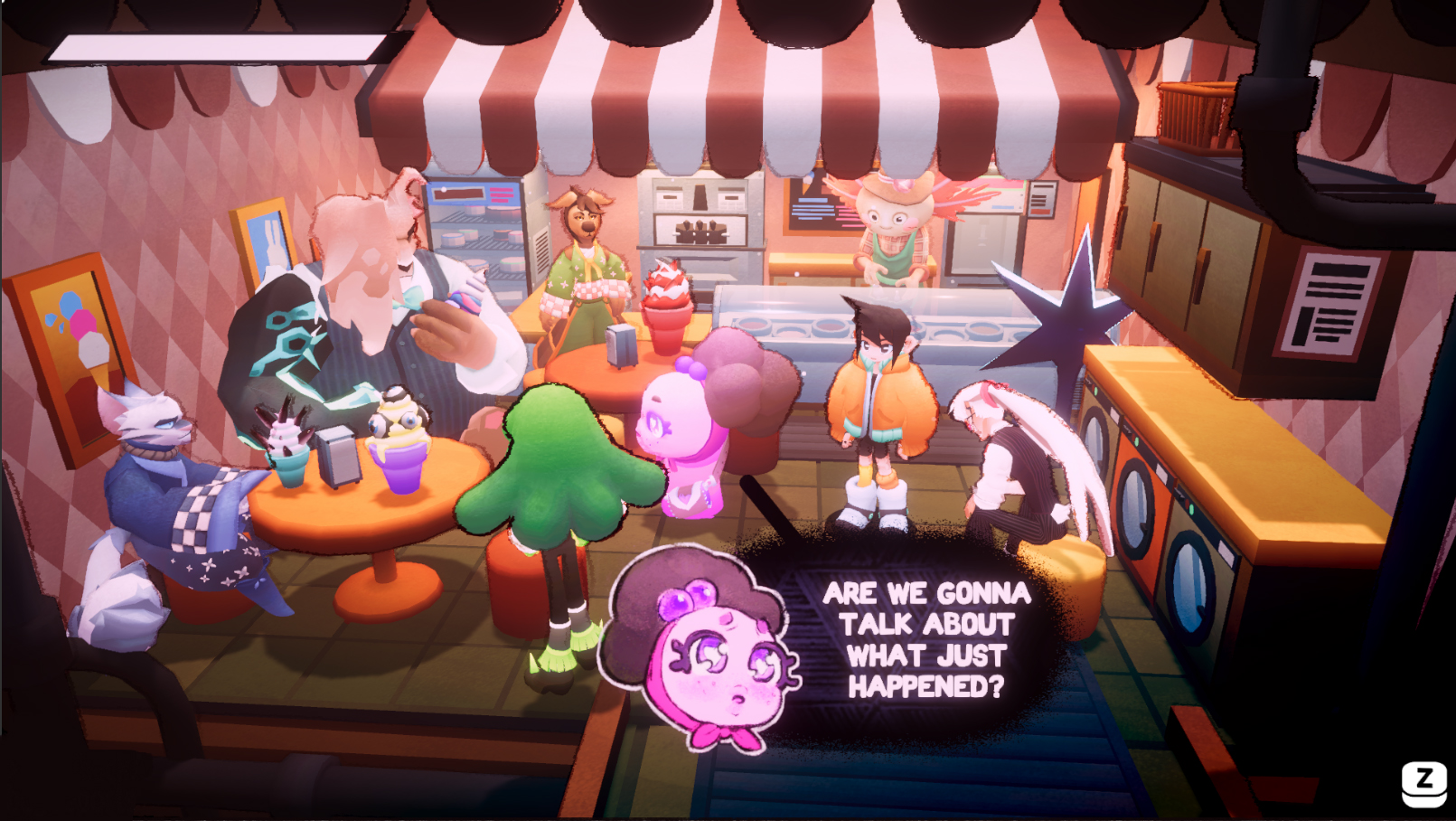 FREERIDE plays just like a 3D open world RPG with the colorful and pseudo-hand-drawn vibes of Paper Mario. I can walk around, strike up conversations with NPCs, pick up objects, give NPC objects, and more. Proto also has the power of telekinesis, meaning that I could telepathically pick objects up and throw them with a drag-click.
The physics of the throwing mechanic were finicky, occasionally misregistering a fully-charged throw or not throwing at all. Thankfully, there weren’t too many instances where I had to use the throw mechanic. When I did have to throw things, though, the finicky physics got in the way.
Much of the storytelling that occurs in FREERIDE is done through cutscenes, but some of the expositional is held too close to the chest. It wasn’t until the halfway point where I began to piece things together regarding Proto’s role and some of the characters’ backstories. While I admire the attempt of utilizing hazy storytelling for the purposes of imagination and a plot twist or two, I wanted a clearer idea of what was at stake. Or, perhaps a better idea of the glue holding the universe together.
 I say this because my actions impacted events in the story, but I was still attempting to figure out how and why things mattered. The aimlessness I felt reminded me of some of the aimlessness I experienced during my first playthrough Athenian Rhapsody – a similar RPG where every playthrough is supposedly different. Here, I was given small indications during intermissions of occasional secrets I came across along with reminders of my actions during each chapter, but it wasn’t until the end where FREERIDE pulled back the curtain to highlight the true antagonist of my story.
By the time I hit the end of Act IV (just under 4 hours, but who’s counting?), the results of my personality test became clear. Based on my actions in-game and dialogue choices, I was told that…I was a socialite. I was open, kind, and aligned with two other values that ultimately led to that conclusion. Do I believe it? Sure. I often consider myself an extroverted introvert, so I can see a world in which I could be described as a socialite.
However…I’m unsure why that matters, and it’s less clear as to what being a socialite in the context of FREERIDE means. A personality quiz is only as insightful as its reporting of results, and FREERIDE glosses over the game’s biggest draw.
I wanted something more from taking a nearly-four-hour-long personality quiz. I didn’t just want to know how many items I threw at spirits, nor did I just want to know an overview of a handful of values that were derived from how I played the games. I wanted to know more about me in the context of how I played.
If I sound overly critical here, it’s because I can’t help but feel like FREERIDE holds back on its descriptiveness. If I behave in an immoral fashion, I want to be told off for being a naughty little boy. UNDERTALE, despite it not being a personality quiz, chides the player for misbehaving. When I took too many pieces of candy from a bowl and knocked it over, I was made to feel bad. When I killed too many enemies, a magic mushroom told me that I lived a life of sin.
That’s a personality assessment, folks. Silly as UNDERTALE is, my behaviors were called out and I was made to feel some type of way for playing as I did. I was also inspired to replay the game to see how things changed when I made different decisions. The Seer in FREERIDE often reminded me that there were branching paths, but it would have been more powerful to remind me of the choices and how those choices defined me in a more upfront manner.
 That said, FREERIDE has charm – quite a bit, in fact. The gifting mechanic gave me several good chuckles, as did some of the NPCs’ dialogue. At one point during Act III, I was presented with the opportunity to make things right for someone else. That moment in particular stuck with me, not because of how I had a similar experience growing up, but because of how authentically FREERIDE captured the rawness of loss and coming to terms with that loss.
Part of FREERIDE’s charm exists because of its soundtrack. Save for a few of the upbeat and tense tracks, much of the ambiance is set to of LoFi and Studio Ghibli-inspired music. Imagine moseying through a snowy mountain with an easygoing vibe. Or perhaps, an upbeat piano track while on a train. The soundtrack complements the game’s overall sense of freedom perfectly.
I had a good time with FREERIDE: The Personality Test. Sure, I had some reservations with the outcome of the personality test and its method of presentation, but it was worth the few hours it took for me to get to the end to get those results. The emotional train ride and delightful soundtrack got me right in the feels.
