


FBC: Firebreak makes a concerted effort to differentiate itself from the horde of team-based multiplayer shooters on the market. Despite making a poor first impression, Remedy Entertainment's charm does a lot of heavy lifting.
Often it’s difficult for a game to escape a poor first impression. And were it not for the pedigree of Remedy Entertainment, FBC: Firebreak may have flown too far under the radar.
One might look at FBC: Firebreak as yet another attempt by another development studio to break out of their safe mold by crafting the derogatory “game designed by committee” usually aimed at live service offerings. While the game certainly wedges itself into familiar, failed territory, I was often impressed by the way Remedy’s quirkiness shined through.
FBC: Firebreak has a beating heart to it, a soul. It feels like a game that is trying to scream out amongst a busy crowd to be noticed. And for all its flaws and frustrations, I’m sure an audience could be fostered. But perhaps the biggest sin committed here was a dizzying first impression that actually took several days to eventually be ironed out.
What we have here is an experience that almost fundamentally changed days after FBC: Firebreak released to the public. I had put several hours into the game before it fully launched on June 17. And then several more as the world was able to get their hands on it. And then, Remedy released a patch that completely overhauled the game’s progression. While that helped soften my opinion towards one of the game’s fundamental problems, it did leave me reeling for awhile.
Though I consider myself well-versed in the constant onslaught of gaming releases (especially from major studios), FBC: Firebreak was an unknown quantity to me until about a month ago when I saw a random social media post about it from Wario64 mentioning a developer livestream. Yes, I know, shame on me… but it happens.
I watched Remedy developers talk about the game and play a few missions from it. “A team-based shooter?” I thought to myself. “Wait… you take a shower to remove status ailments?” “An objective is to destroy sticky notes that can kill you and turn you into a monster?” The strange things I was hearing and seeing on this developer stream only ignited my interest further. I love a good, weird premise and I enjoy satisfying gunplay just as much. I certainly don’t have many friends to pull together a group but that’s okay, right?
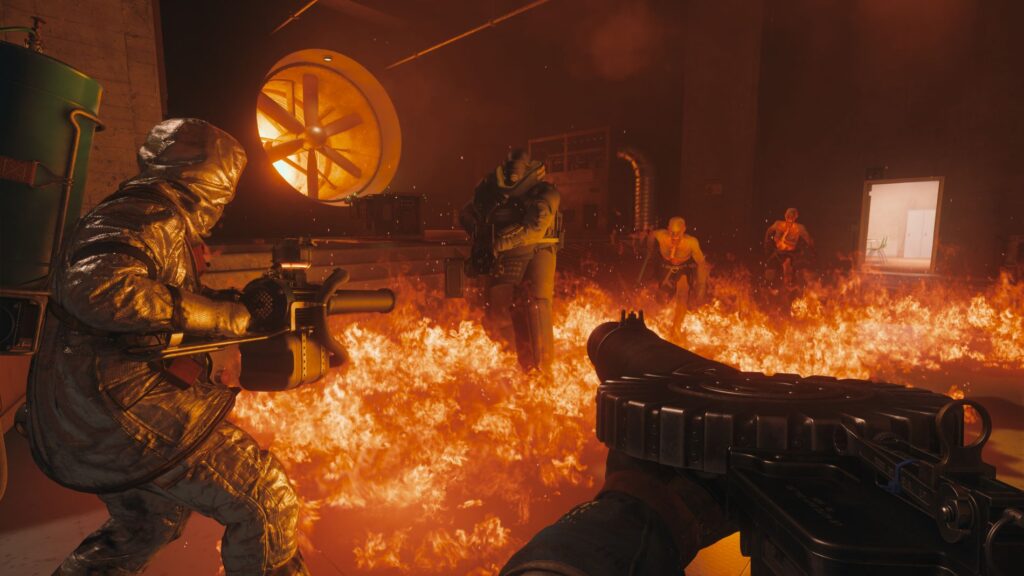
When FBC: Firebreak finally got into my hands, I was relatively excited to spend the weekend with it despite knowing that the player pool may be somewhat limited in the pre-release environment. Eager to start, I waited a few minutes to allow the game to flash tutorial text on the main screens. Once I started matchmaking, a few seconds passed until I was shot into a round currently in progress with one other player. “Ah yes, the one from the livestream where we need to turn off fans in the furnace area or constantly build up heat before catching on fire,” I thought. And in less than five minutes, the match was over.
There’s no two ways about it, FBC: Firebreak does a loathsome job at introducing players to its fundamentals.
Without an introductory level acting as a drip-feed of information for the player, explanations are few and far between. It borders on off-putting because minutes into my second match I ran out of ammo. I couldn’t figure out how to acquire more bullets to my SMG. None of the enemies appeared to be dropping any. I ran around the level avoiding sticky notes and smacking Hiss with the butt of my gun. I thought an ammo drop would be on a cabinet or desk or alcove somewhere. Nope.
It wasn’t until the third mission I finally saw an ammunition refill station. “Oh,” I thought.
Years of gaming experience has ingrained in me the idea that while I may not be an expert at games, my broad taste allows me to “get” a game fairly early on and understand the fundamentals. FBC: Firebreak may be a PvE game pitting a team of up to three players against hordes of enemies while attempting to complete objectives, but Remedy’s attempts at spicing up the genre need to hold players’ hands a bit more.
Conceptually, it’s all relatively simple. FBC: Firebreak is set in the same universe as Remedy’s phenomenal 2019 game Control. Taking place in the shifting Oldest House where the Federal Bureau of Control operates out of, players take on the role of Firebreak members trying to contain disasters taking place in somewhat familiar locales from Control. While the game is tangentially related to Control, don’t expect anything but the loosest connections as the story in FBC: Firebreak is practically non-existent.
Honestly, I didn’t mind that Remedy opted not to expand its universe too broadly, only incorporating passing nods and themes from Control. There’s a soft bit of humor when the cast jokes about being a cog in the machine and workplace comedy in this bizarre setting can provide some chuckles. But this is a game squarely focused on a strict gameplay loop that uses the fascinating Remedy universe to make for interesting objectives.
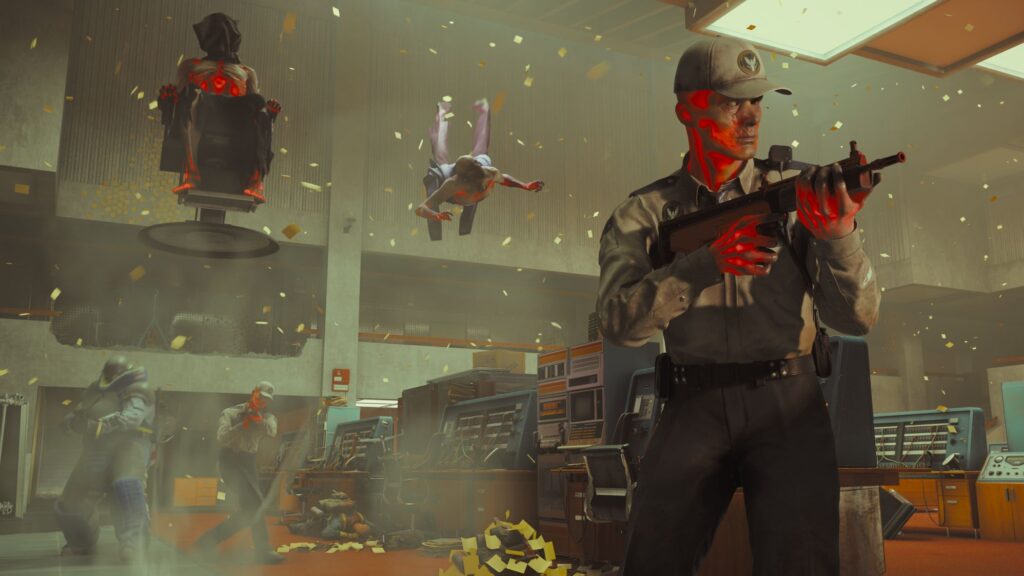
FBC: Firebreak incorporates the Hiss as its primary foes. These possessed and altered former humans were the fodder in Control but they are more so that role in this game. Pulling a page from the likes of Left 4 Dead, Remedy tosses a few different types of Hiss at the player but only a handful are truly intimidating. 75 percent of the Hiss are the basic zombie-like melee type that rush the player in large numbers. Security guard Hiss take potshots at the player while creepy ones in office chairs float around firing projectiles. Tankier units that shoot a grenade launcher, are only weak to a certain back-facing spot, or go invisible are more common in higher difficulties.
As creative as the Hiss are, in execution they aren’t that enthralling in FBC: Firebreak. A mildly skilled team of players should easily be able to dispatch the foes, with experienced players figuring out ways to cheese attack patterns. While the small roster of Hiss are threatening enough to be dangerous, their challenge is usually in their random spawns and how they can take the player by surprise. More than anything, the Hiss are meant to be an impediment to the player completing objectives, not the objectives themselves. And sometimes that friction is okay, other times it’s more frustrating than it should be.
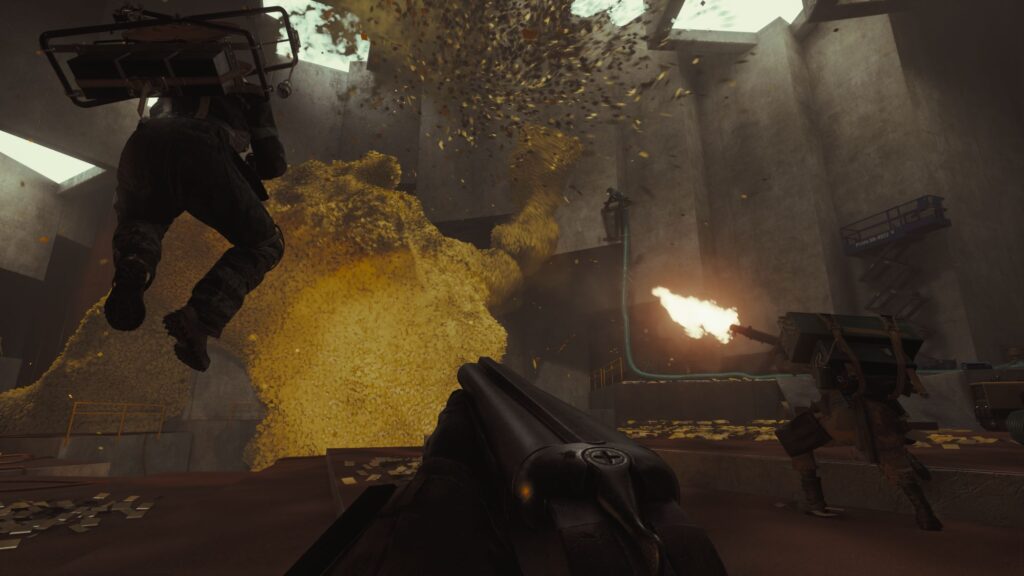
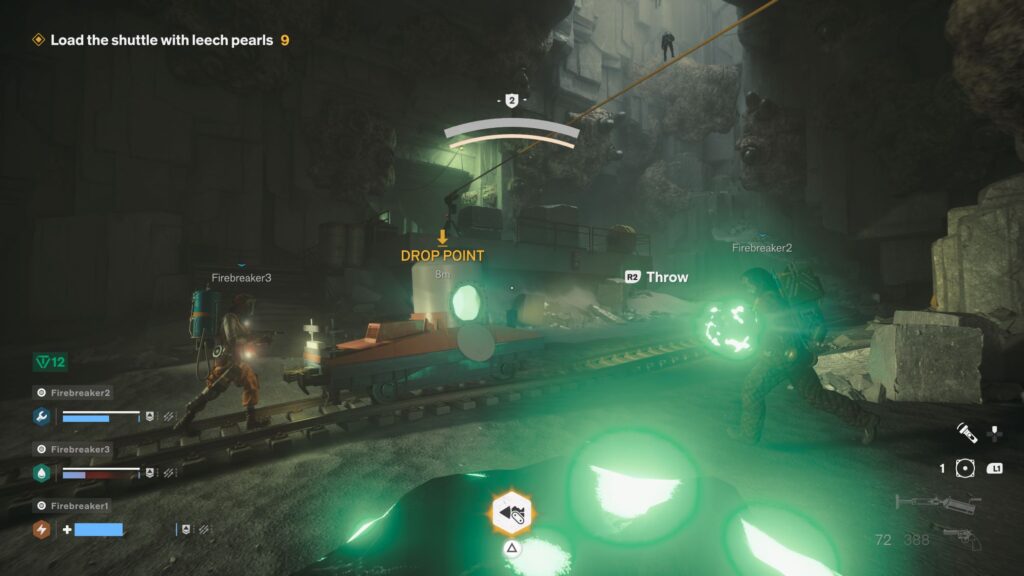
For me, FBC: Firebreak‘s greatest asset is its quirky mission design that tries to take into account the varying elements of party makeup, shooting, environmental effects, and incorporating the Control universe into a team-based FPS. In one mission, players need to blast away toxic pink gunk to get generators running while also avoiding the gunk’s encroaching movement. It’s strangely claustrophobic in parts as players have to constantly blast paths and watch their step, creating sightlines for potential floods of hiss. In another, radioactive pearls are earned by shooting leeches embedded in quarry rock. One level ends in a fight against a massive sticky note monster.
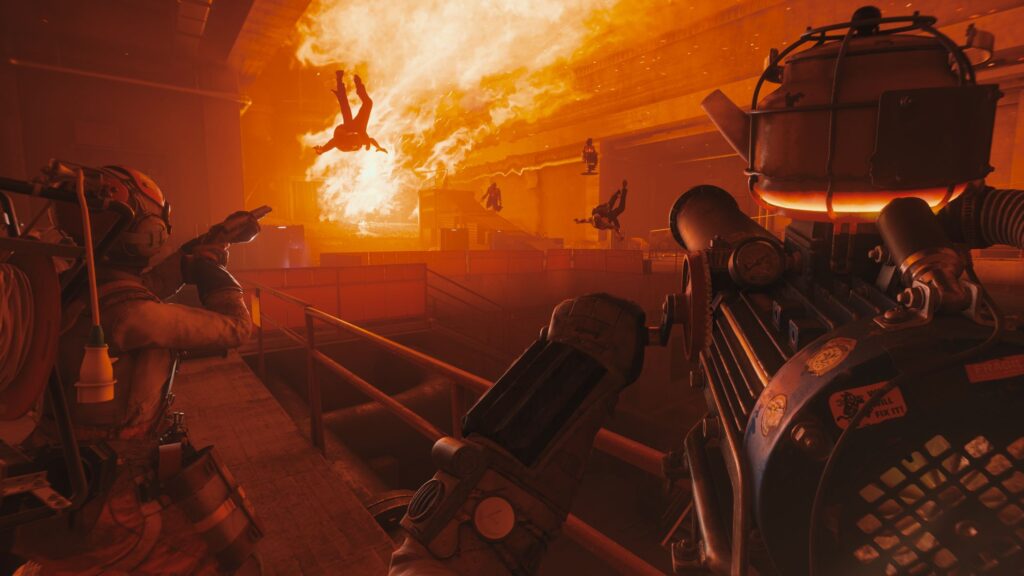
In terms of visual appeal, each of these levels is self-contained and hones in on colors and themes, making them interesting and distinct. It’s almost as if each bespoke mission in FBC: Firebreak is color-coded and does not wish to blend in with others.
In the level “Hot Fix” players run around trying to avoid death while turning on fans in a random order, hoping to stave off the constant build-up of heat that will eventually burn the player, rapidly ticking away health. The mission ends in a chaotic battle of filling barrels with a substance to shut down a furnace that intermittently blasts out deadly heat that kills enemies and the player. There’s cart escorts here, except that the cart is radioactive.
If stripped of the veneer of Remedy and Control, FBC: Firebreak would be infinitely more repetitive and significantly less appealing. While the objectives should be familiar to anyone who has played this kind of game before, they are done in a way that makes them random and interesting enough.
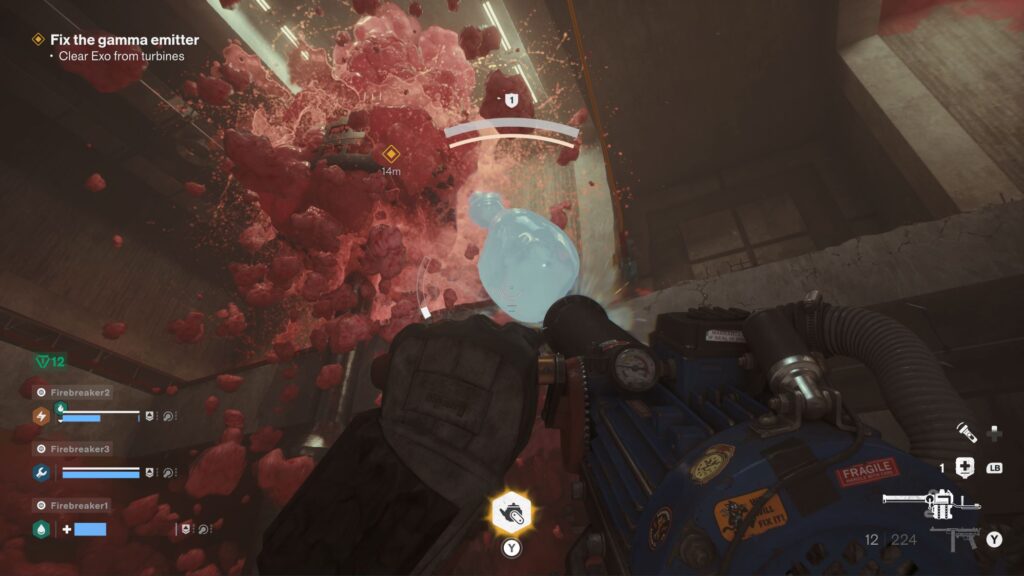
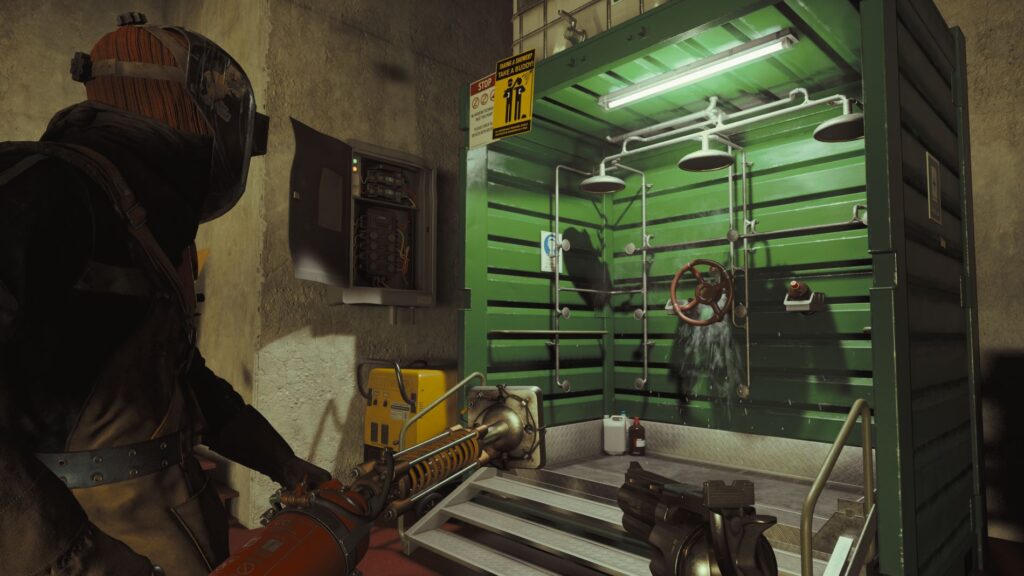
A large emphasis is placed on the smaller details in the middle of a mission and how a team of three players should incorporate the three separate “job” classes in the game. Referred to as Crisis Kits, each one features a unique weapon or tool that adds utility for the player. A large part of my time was spent using the Splash Kit, who comes equipped with a gun that shoots out globs of water. Water in FBC: Firebreak is one of the most essential things players need to keep in mind. Being drenched in a shower restores health and melts away status effects and having a character that can cool off players, moisten sticky notes, and prime enemies for being electrocuted is a godsend. The Fix Kit uses a large wrench that can bash enemies but also fix broken electric panels used to light up the area, or broken showers and ammo stations. The Jump Kit wields an electric… thingy… that can quickly power up devices and stun enemies.
In FBC: Firebreak, any of the three roles can accomplish most tasks. Fires can be put out, consoles can be fixed, showers can be repaired all by initiating a small mini-game where the player hits shoulder buttons as prompted, with an incorrect input causing a small amount of damage but also adding pressure from incoming enemies. But why do that for a fire when a water gun can splash it out? Littered around the levels are ceiling sprinklers that can fill in some gaps but having that Splash Kit player is always helpful.
When I switched to the Jump and Fix Kits, I noticed a difference in what I was lacking from Splash. It isn’t essential that all players be a different Kit but a team that uses all three and communicates can dominate a level quite well.
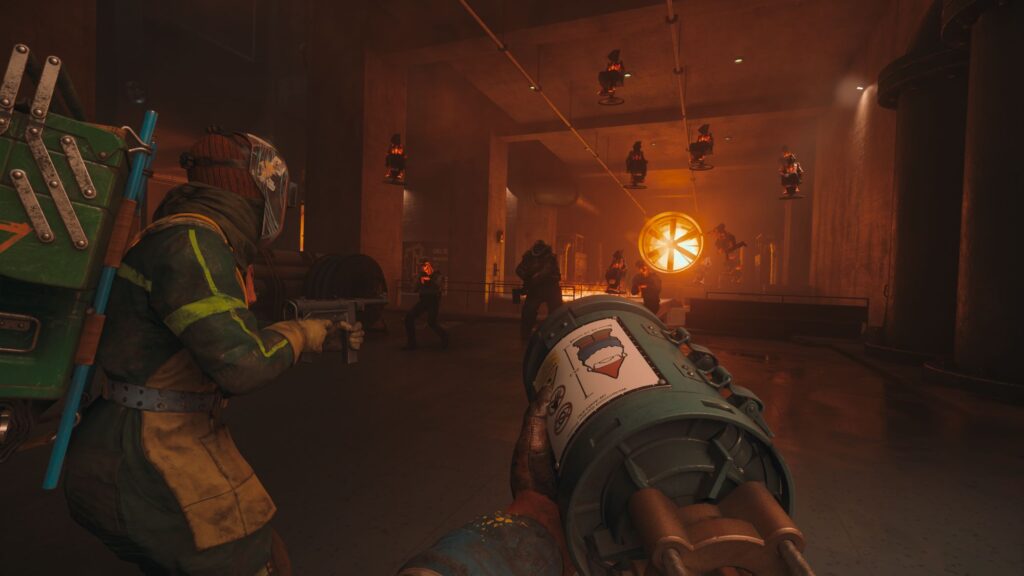
Ultimately the goal in FBC: Firebreak, like many games of this type, is to run missions over and over again until being able to craft a build that can take on the hardest challenges with ease. But for players this will be a difficult hurdle to get over initially because Remedy simply does not explain status effects, barely explains the Kits, and hardly divulges many of the game’s quirks.
Each mission has three clearance levels, which indicate the amount of tasks players have to complete. Clearance level 1 usually ends quickly after one objective has been completed. My first time in the quarry, the second I loaded up radioactive pearls into the car, I was asked to go to the escape elevator, wait out the time, and escape after killing a “named” enemy that is literally a normal Hiss with more health.
Adding onto the clearance levels, players can choose four separate difficulty levels, which are not explained well. Are enemies harder? Do they have more health? Is it easier to have status ailments? On top of that, players can further add a modifier to the level by selecting whether or not Corrupted Items will appear. These Corrupted items are kind of fun–adding low gravity, speedier enemies, exploding corpses–and can be destroyed by finding the right item, yet the game still does not explain them well.
Worse yet, attempting to matchmake either through Quick Play or selecting a mission is a pain because players are asked to select what clearance and difficulty level they want, and if they want corrupted items to appear. This dilutes the player pool so bad that I simply never matchmade into anything except the first two jobs. Some kind of lobby would have helped greatly as it felt no one was ever attempting to play anything on the highest clearance on the hardest settings.
Progression is build upon being able to tackle these increasingly harder odds and more objectives to juggle. Rewards are granted in the form of materials and documents that act as currency for upgrades. Players have an account level that dictates when new perks will be unlocked. Each Crisis Kit has its own individual level as well, with each new level unlocking a new perk slot. Perks like giving bullets status damage, increasing the speed of repairing, making the time of adding new lives shorter, and increasing ammo capacity are great. But many perks take a massive time investment. After about 20 hours of play i was hovering around level 30 and some perks were tucked away several levels ahead of me.
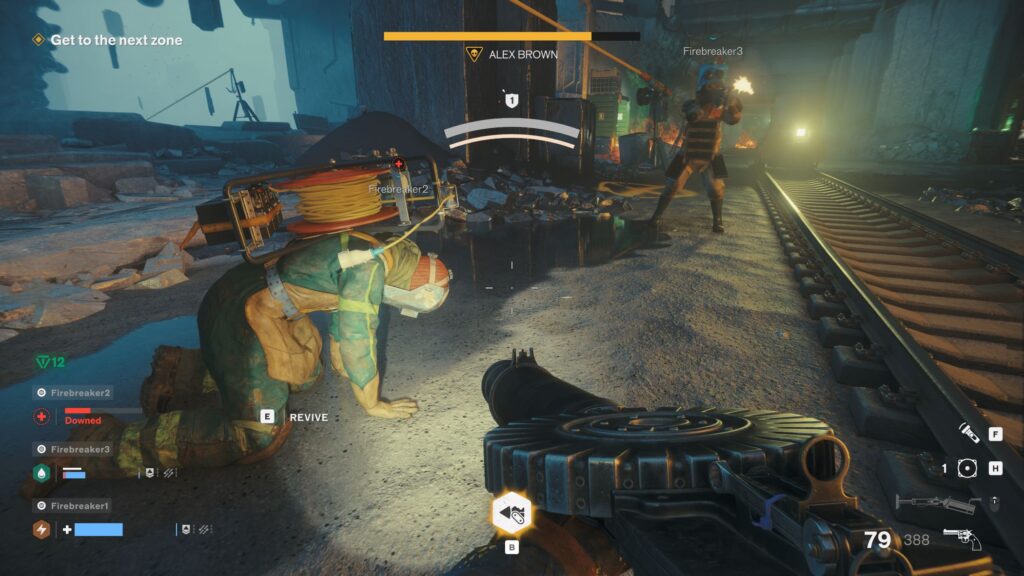
This perk research is unlocked and upgraded by materials found specifically in each mission and a universal currency called Lost Assets usually rewarding by killing named foes.
However, Remedy introduced a patch that completely overhauled the progression in FBC: Firebreak.
Initially the entire loop of progression in the game was borderline exhausting. Upgrades that improved weapons, item damage, and added capabilities to each Crisis Kit were locked in a Requisitions tab that had individual pages. Players were required to spend Lost Assets before a new page with new upgrades would be unlocked. But that also meant players had to spend Lost Assets on cosmetic items that didn’t influence gameplay at all. It was a frustrating system, especially knowing players would need hundreds of Lost Assets to get the upgrade they wanted, along with countless hours of stagnant progression.
Honestly, it was a massive oversight and stripped any feeling of reward from FBC: Firebreak. Thankfully Remedy quickly fixed the problem, even if it was a few days after the game launched. Now, cosmetic items are entirely separate. When the patch deployed, I was finally able to buy and upgrade for the SMG I had been relying on. It felt… great.
But again, the problem was simply that the path towards this progression was mishandled. Even the upgrade materials to improve perks to the point where they could be shared with the entire team if you were close enough was looking difficult. These materials were barely visible and the patch improved how much they stand out.
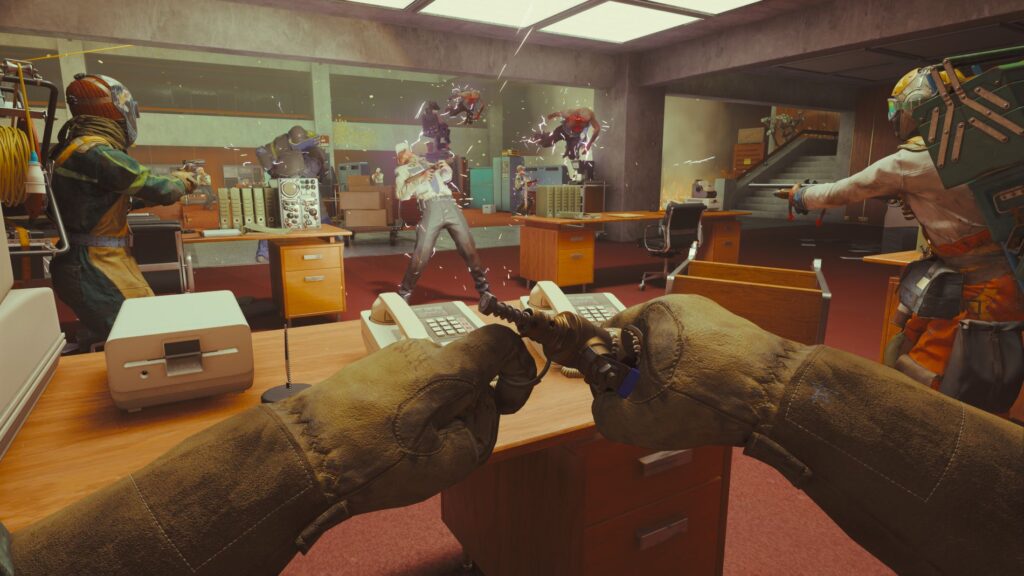
FBC: Firebreak isn’t content rich and isn’t entirely innovative in the space it occupies. That being said, the shooting is surprisingly good and the coordination required by a team really extracts a lot of fun in the way a good horde shooter can be. It’s just frustrating that all of its better elements are obscured by frustration. And the worst part is the looming question of whether or not the game will find an audience that sticks around for the long haul. Even the best games struggle anymore to captivate. And that’s too difficult a future to predict here.
FBC: Firebreak is unlike anything Remedy Entertainment has made. While a team-based shooter would not be on everyone’s wishlist from the storied developer, it makes the best of Control‘s unique universe. Bizarre mission objectives and a friendly approach offer enough diversity to draw players in. But a troublesome onboarding process may negatively color the crucial first few hours for players. Should a community form around FBC: Firebreak, there’s a lot to enjoy and hopefully Remedy will continue to support the game in the coming months.