


I want to live in a world where games retain their core gameplay all the while becoming more accessible to new players with minimal compromises. Paradox is making that true with Europa Universalis V. With its automation, friendlier UI, and fleshed out playstyles outside of expansion, it’s a grand strategy game that is innately fun, endlessly engaging, and worth the decade’s wait.
Paradox Interactive’s approach to announcing Europa Universalis V was quite novel, albeit one that’s been an open secret for over a year. After multiple developer blogs about an unreleased game titled “Project Caesar,” they suddenly announced in May of 2025 that Europa Universalis V was coming in November of this year. All that time talking about Project Caesar was a clever way of telling players about what they wanted to change, what they actually changed, and why they made those changes.
Talk about keeping players in the loop, huh?
Europa Universalis is a historical simulation title that has players build gigantic empires throughout hundreds and hundreds of years of human history. If the Civilization series celebrates historical leaders’ rise to power and subsequent legacies, the EU series celebrates the rise and fall of micronations nested deeply within historically accurate concepts. There’s no turn-based gameplay; EU utilizes realtime simulation that can be slowed down to hours or sped up to pass through entire months in mere seconds.
I’ve had the pleasure of playing Europa Universalis IV off and on for over a decade (as it was released in 2013). It’s stood the test of time as Paradox has expanded it with DLC expansion after DLC expansion (some of which have been criticized as being overly buggy), broadening the playable world within the game and adding flavor to every new region. It’s one of the best historically-grounded simulations out there. If you head over to EUIV’s subreddit, you can see player after player show results of their silly conquests. If you’ve ever wanted to expand the Ottoman Empire across all of Eastern Europe, you can do that. If you’ve ever wanted to see the Qing Dynasty expand into Mesoamerica, you can do that, too! Swedes controlling Brazil? Sure, why not!
The possibilities are endless.
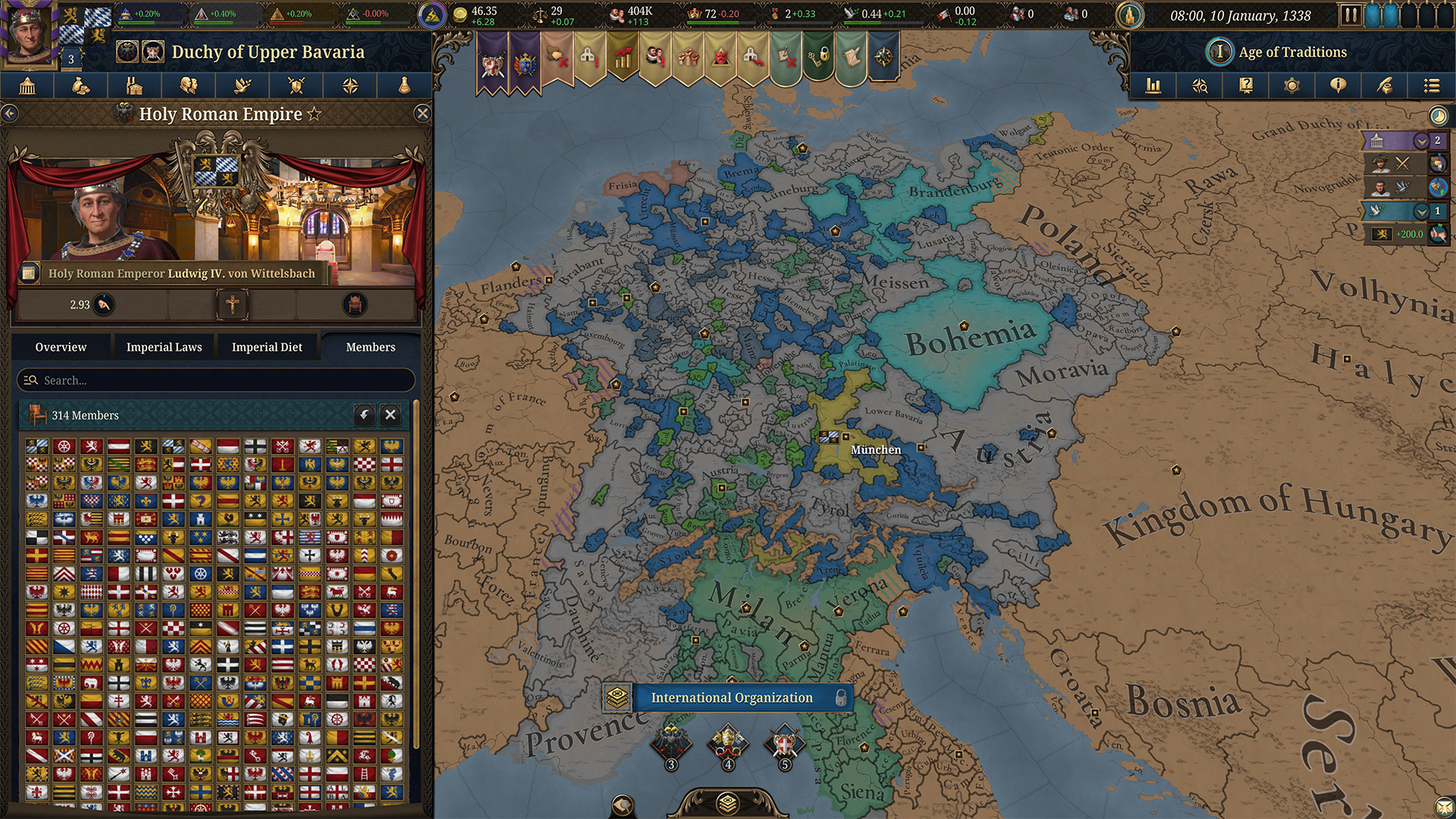 The problem with the EU series is that it is notoriously difficult to understand. I’ve seen players online describe it as the game where you don’t know what you’re doing for hundreds of hours until the thousand-hour mark, then things make sense and you become engrossed with the games. Players these days don’t give games the chance to blossom – look at how players critiqued Starfield for requiring 30 hours (or so) to lift off. I didn’t hit the thousand-hour mark of playing EUIV, so I’m technically an outsider who’s very interested in the series
From that outsider’s perspective, Paradox made leaps and bounds of improvements within EUV. I can’t help but think back to Civilization VII’s release as I write this review. Where Firaxis opted to make changes for the sake of making changes (some of which do benefit the game’s balance, don’t get me wrong), Paradox opted to make refinements across the board all the while preserving what makes an EU game an EU game.
It’s clear that Paradox has designed EUV to align with Victoria 3’s design philosophy, erring on management, simulating novel cultural expansions, and constructing the social fabric your nation in a way that you see fit. Expansion feels less like a requirement in EUV; should you want to expand the Philippines to encompass all of Eastern Asia, you can still do that. If you want to build the perfect country, isolated from the rest of the world’s riff-raff, EUV gives you the tools you need to do so and is just as rewarding as painting the gigantic map a single color.
Frankly, it’s refreshing. I am not the type of simulation player who wants to always build broad and take over country after country, although I occasionally get the urge to be that warmonger. I mostly prefer to build upwards, crafting my perfect country the way I want it. Paradox’s classic approach to granular management gives me a myriad of levers to get to that ideal creation.
It’s just a lot. For most (read: players unfamiliar with a Paradox title), Europa Universalis is a classic case of information overload. There are windows within windows, oodles of mechanics, and seemingly infinite granular options that seem miniscule until they snowball into a catastrophic event. Oh, and there’s hundreds of countries to choose from.
Where do we start, then? Remember that EUV is more of a simulation than a board game with set win conditions that are cross-applicable to every other player. Part of my original struggles with EUIV was how I was let loose way too early after the tutorial. I didn’t know where I should start, what goals to consider, and so forth. EUV, on the other hand, seems to have learned from the “let the player run wild” criticism and has given me a sense of direction with the Agenda, an in-game window that gives me hints, historical context (for those wanting to prepare for the AP European History exam), and a rundown of current elements that impact the my chosen country.
 The Agenda window is the perfect way of giving less-informed players a sense of place within the grand simulation that is EUV. For instance, in one of my Norway playthroughs, the Agenda recommended that I build roads from the capital (which increases proximity and control), increasing maritime presence (which also builds proximity), find new towns in near harbors, expand industries via founding guilds, and strengthen my union with Sweden to guarantee peace. Notice anything about those hints? They’re direct. They’re easy to understand. Best yet, they’re all within the confines of Norway’s political playstyle that’s all about playing the political game instead of expanding via economic policies or war.
The Agenda window does more than tailor country-specific hints. For instance, I was messing around with Minting by producing far more ducats than necessary (for SCIENCE!). This inevitably led to some inflation. The Agenda informed me of concrete steps I could take to correct that inflation and restore some sense of financial stability in my kingdom.
None of them were required to proceed. The Agenda wasn’t pushing me to play a specific way, nor was it positioned in some obfuscated fashion that only a player of hundreds of hours would know where to find. It was tucked away in the upper right, available for me when I needed it.
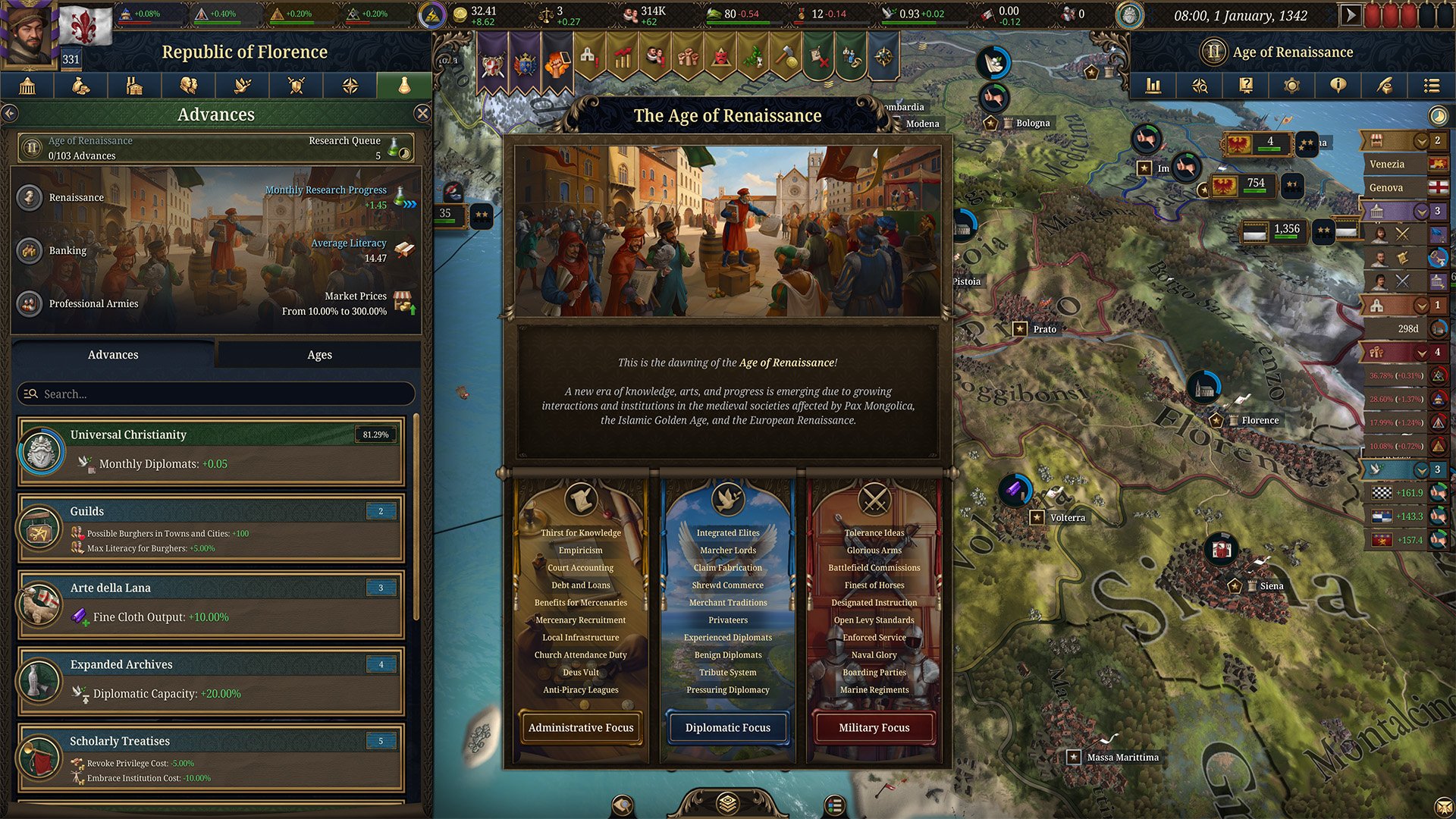
Missions felt, and were, far easier to complete than in EUIV, at least from a less-seasoned player’s perspective. The generic missions of the previous title along with the country-specific missions were framed fine, but I would often struggle to figure out how to best accomplish them. EUV has simplified missions in part with the nested tooltip system along with outlining the specific steps needed to complete the mission. For instance, when I was tasked with building a library, that required me to acquire books, which in turn required other resources to build that library. Another mission tasked me with boosting stability, and the tooltips gave me several recommendations on steps that I could take to accomplish that mission.
The decision to redesign nested tooltips in EUV is especially brilliant, as it opts for on-demand windows that can be quickly seen from hovering instead of clicking through term after term. Important concepts are highlighted and easily recognizable with the blue font. I had very little trouble relearning concepts from EUIV along with building my country how I saw fit.
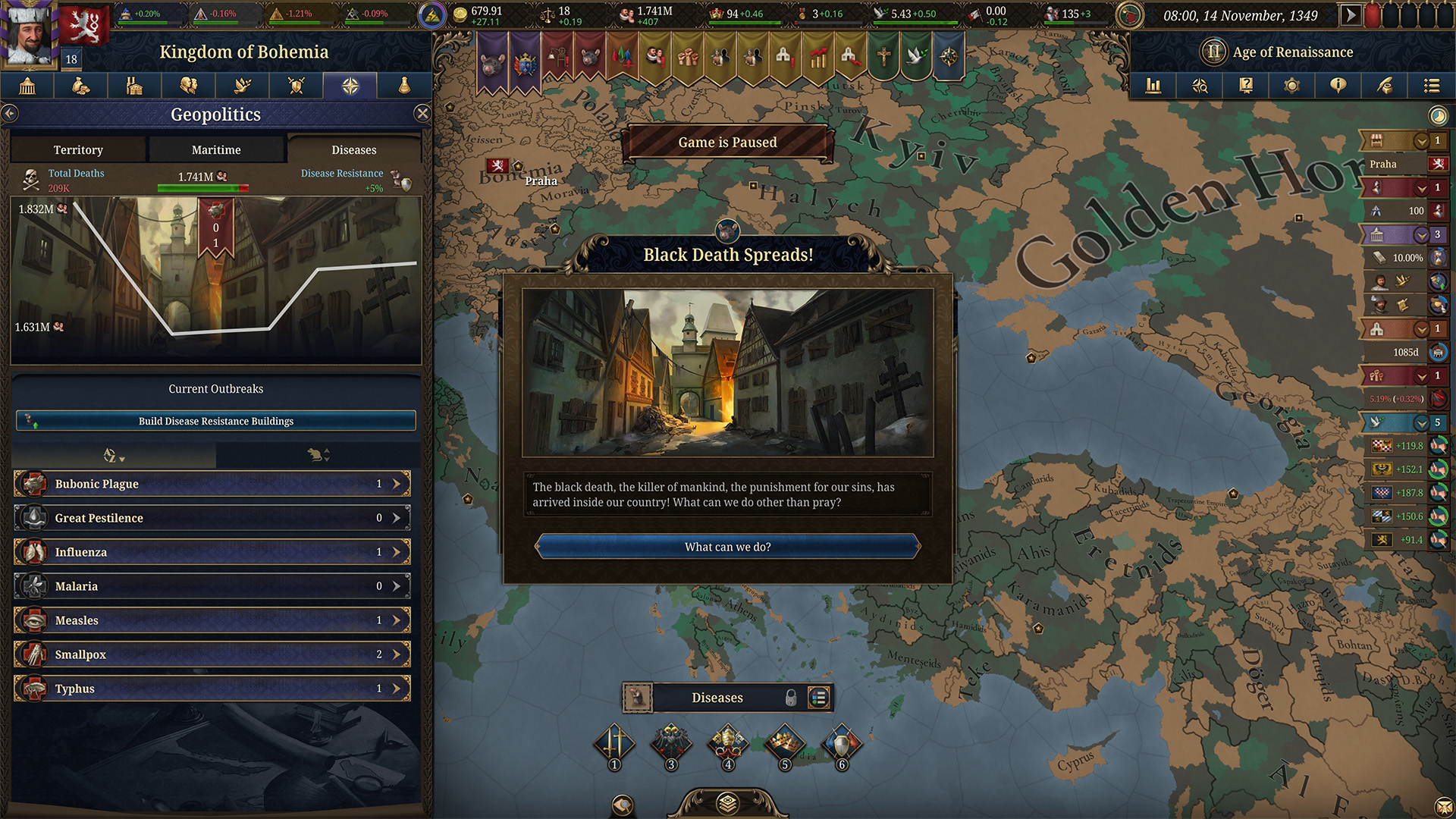 EUV has redesigned the trade and population system for the better. New to the EU series (but not new to other Paradox titles) is the introduction of “pops,” which are EUV’s units of humanity. Every little micronation, villa, and state has pops that require sustenance (resources) and attention. Trading is centered on what the nation’s pops needs. Raw goods are produced in operations using laborers and buildings (both of which draw from the pool of pops).
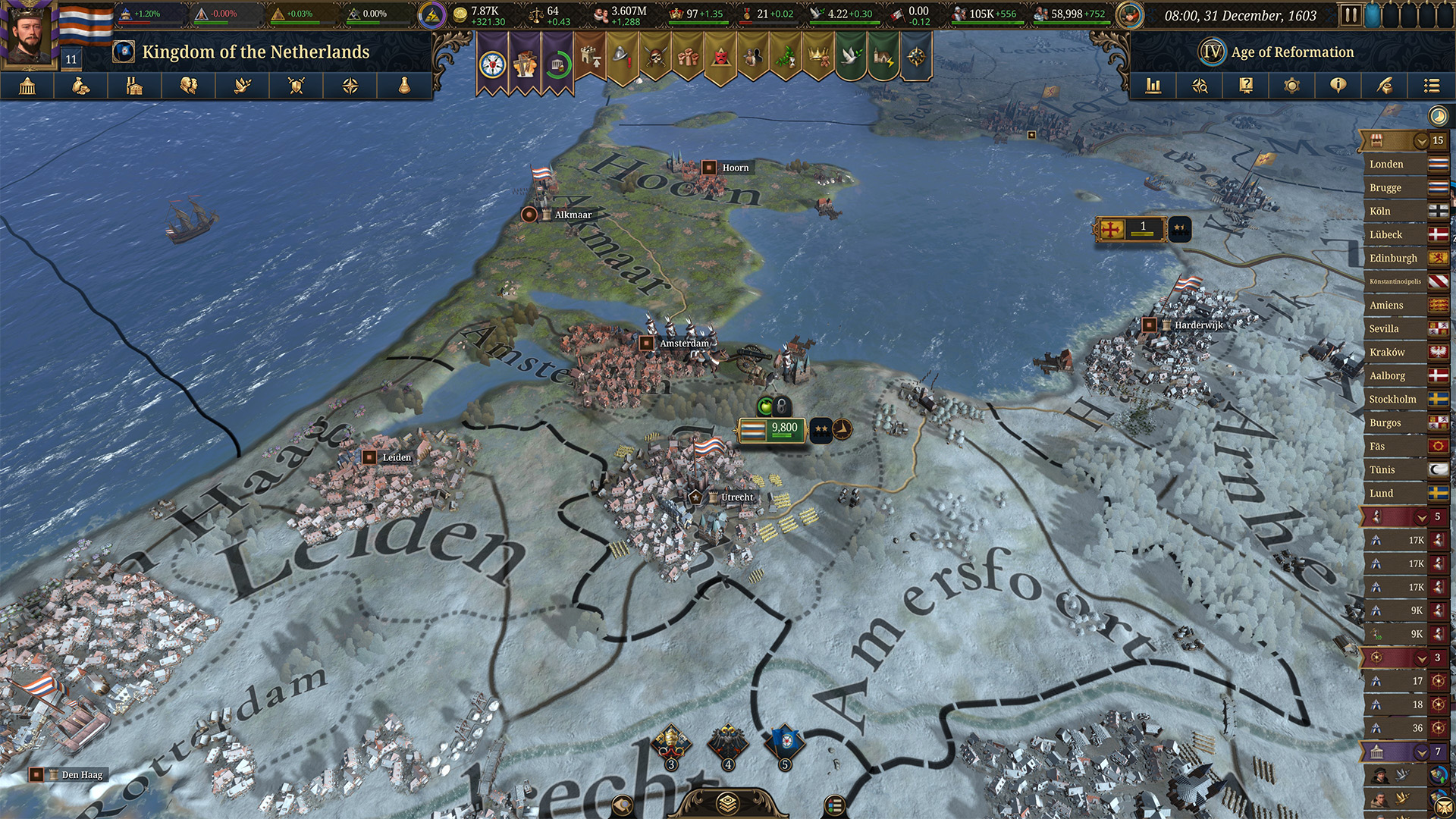
The real-time system of previous EU titles remains, albeit expanded. EUV has added the option to slow down time to an hour-by-hour basis, a feature that benefits battles by avoiding them drawing out over several months. The introduction of hours does not make EUV longer to play. If anything, it makes armies easier to manage during periods of combat.
Let’s talk about EUV’s automation. New to the series is an automation feature that allows the computer to step in and take over gameplay elements that you would prefer not to handle. If you wanted, it could automate most of the simulation aspects.
I’m not typically one to hand over the reigns of my machinations to AI, especially once I have spent hours upon hours fiddling with each slider, button, and mechanic. If anything, I don’t want anyone else but me to touch the hours of work I have put into my country. But I am a flawed human. I make mistakes. The AI of EUV showed me how flawed I was when I set aside my pride and let it handle my military.
During one of my playthroughs, I was the Kingdom of Norway, one of several countries where diplomacy is the end goal rather than wartime brute force or economic domination. I had spent the first “age” (which is EU’s way of breaking out the game into phases with unique rulesets) making slow progress on building up Oslo (my capital) and surrounding villas. One thing was an issue, though: My stability, ducats, and prestige were very low. I was unable to complete one of the diplomatic missions because I lacked the prerequisite amount of stability. Perhaps I was doing something wrong?
 I automated the production of goods in an attempt to rebuild my economy (for science, of course). I wanted to see how it approached adjusting Norway’s economy, especially when I was frequently embattled by plagues and harsh winters. After several months, the AI had improved my economy leaps and bounds, investing in resources that I had overlooked and creating jobs for my jobless pops. After two years, my monthly income had doubled and control over the region had immensely improved.
I then gave it more control. I automated everything I could just to see what would happen, all the while making adjustments to my kingdom’s cabinet (no more advisors, thank you!), missives, and diplomatic objectives. I watched it undo some of my actions (to my dismay) and implemented new policies, thus improving my nation’s global rank year after year. The automations were showing me what I was doing wrong and setting me up for success.
Europa Universalis V’s automation is automation done exceptionally well. You don’t have to enable it. If you’re thousands of hours into the series and are confident in your abilities, you can keep it disabled and move along. Conversely, if you’re the kind of player who doesn’t want to handle micromanaging an army because diplomacy and economics are much better (like me), you can do that, too. If you’re a new player, the AI is there for you to give you glimpses into what to do to become a better EUV player.
I can see myself investing another hundred or so hours into EUV, as I’ve learned more about how to succeed in an EU title in these few short weeks than I ever had when attempting to learn (and relearn) the fourth installment.
I want to live in a world where games retain their core gameplay all the while becoming more accessible to new players with minimal compromises. Paradox is making that true with Europa Universalis V. With its automation, friendlier UI, and fleshed out playstyles outside of expansion, it’s a grand strategy game that is innately fun, endlessly engaging, and worth the decade’s wait.
