


On the basis of the shifted gameplay loop involving racing against the clock, Fate of the Phoenix presents a more hectic, difficult, yet rewarding way to play Europa Universalis V.
We’ve reached the point in Paradox Interactive’s Europa Universalis V’s life cycle for it to receive its first DLC, titled Fate of the Phoenix. For comparison’s sake, Fate of the Phoenix is being released seemingly as quickly as EU IV and the release of Conquest of Paradise around six months after the game’s launch. It’s not as though Paradox is attempting to course correct their design decisions and locking gameplay changes behind a paid expansion. The opposite is occurring, it seems, as evidenced by their recent roadmap that contains a litany of free updates that are slated to release just about every quarter this year.
If you recall my original review of EUV, I was quite happy with the changes made to the base game and enthralled by the potential of more players than ever before having the ability to dive in and get hooked into the deep, nearly endlessly immersive, and highly expansive empire sim that players have spent thousands of hours playing over the duration of their lives. I’m aware that some players (especially longtime EUIV fans) might see things differently, but I stand firm in my belief that EUV is fantastic. Sure, some of the AI of the base game might be too aggressive. Sure, some elements of the UI might feel unpolished compared to the now-thirteen-year-old EUIV. The fact remains that EUV contains an abundance of complexity that exceeds that of EUIV at launch.
Fate of the Phoenix is EUV’s approach to a curated and immersive Byzantine Empire run through. It gives the player unique content (think of in-game events) that closely aligns with the rich history of the Byzantine Empire, but with several deviations.
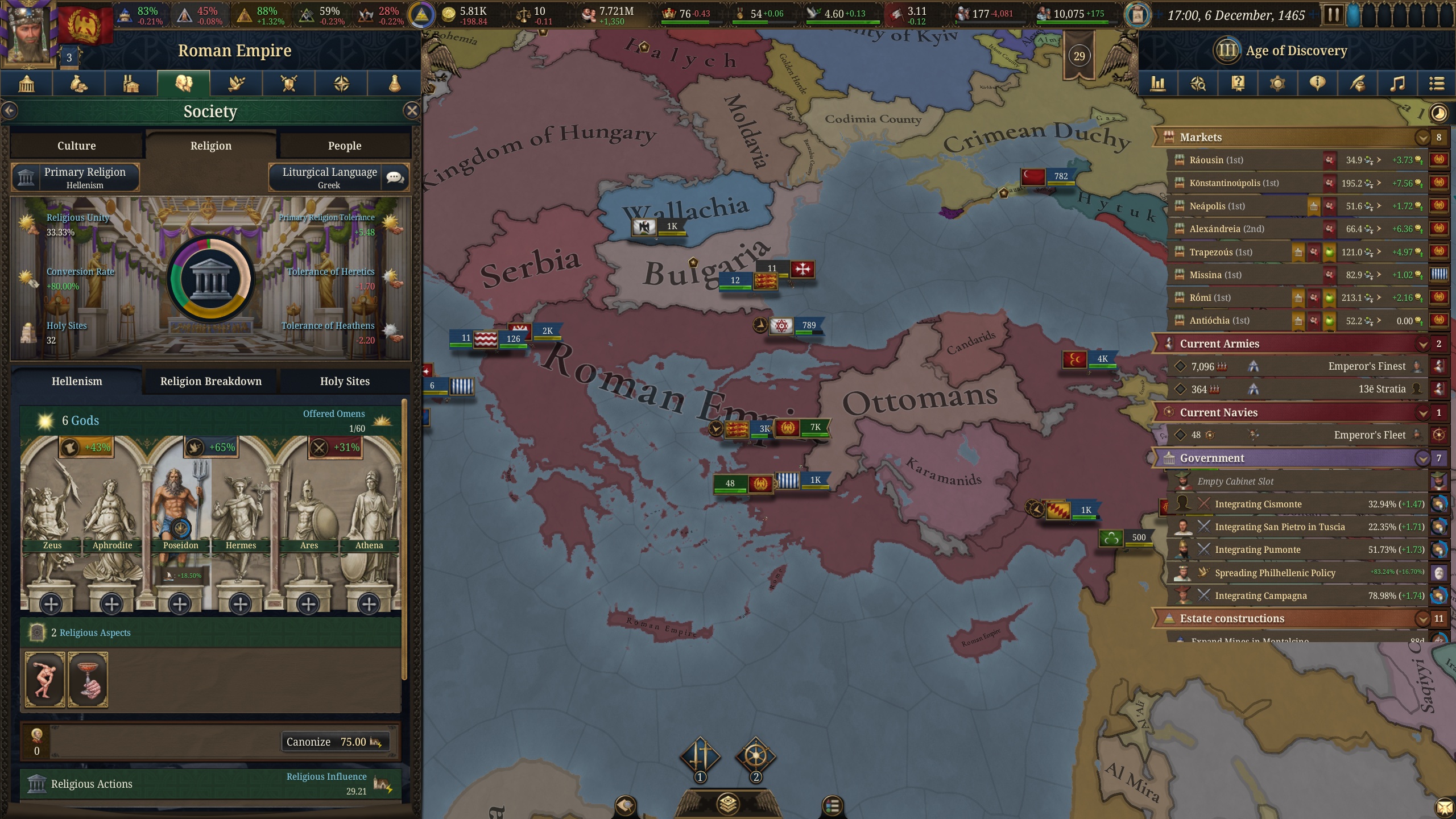 The “Fate of the Phoenix” disaster loomed over my runs, constantly reminding me of the inevitable Rise of the Turks (which already could happen in the base game, except here it’s modeled closely after history) alongside Serbia and Bulgaria threatening my borders. I was tasked with managing the heart of the Byzantine Empire in an attempt to stave off the historical threats and rewrite history. Right from the jump, it felt like I was racing against the clock and constantly putting out fires to the best of my abilities. Taking on the standard missions didn’t feel feasible here given the constant instability I was facing alongside monthly events related to the historical disasters. If you thought playing Byzantine was too easy, or even too formulaic, Fate of the Phoenix turns that argument on its head by forcing me to adapt to perpetual strife.
The game starts with the Byzantine Empire in debt, over-expanded, very little legitimacy, inflation, and other negative modifiers that most often occur when the player makes foolish (or perhaps…risky) decisions after a few years. I didn’t expect to encounter these issues right from the jump!
There are novel ways of staving off my opponents. For instance, one of my first main actions I was to take was to Request a Roman Donation. Except…I couldn’t do that because I had already declared the Papal States as a rival. Instead, I chose to Patronize the Orthodox Monastery and strengthen my empire’s religion. Fate of the Phoenix expected me to forgo the missions tree (that I had become accustomed to using during each of my typical playthroughs).
The additional Orthodox content felt like Paradox took a meaningful stab at making empire-specific content. The new Hellenic religion and Latinitas vs. Romanismos societal value feel historically accurate, but they don’t feel like they impact a run beyond flavor content. Look, flavor content is important for an immersion pack like Fate of the Phoenix, but it would behoove this DLC pack to make these new empire-specific content the focus it deserves. For now, it feels like new content functions similarly to the old, albeit with a Greco-Roman coat of paint.
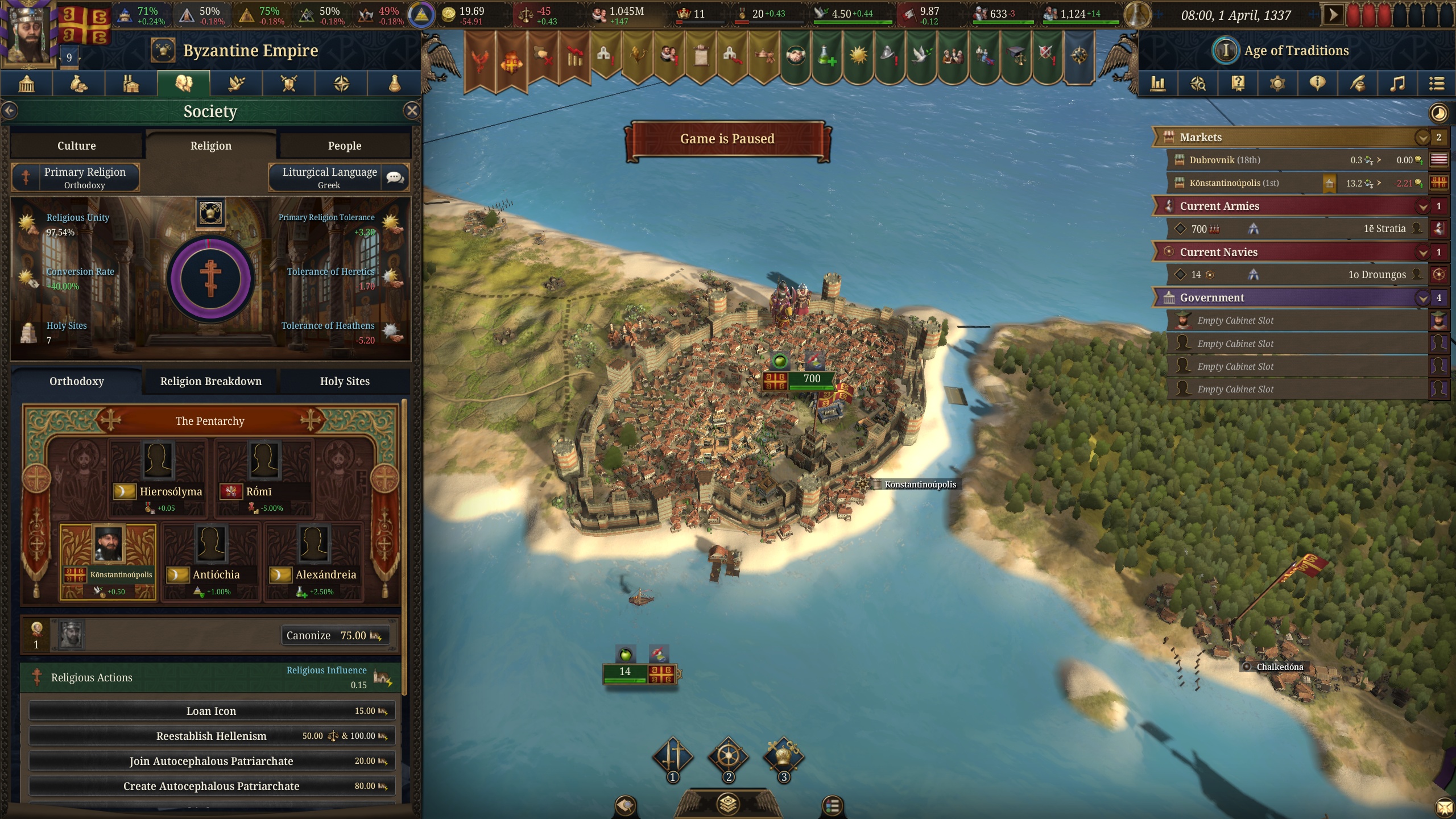 For funsies, I enabled the AI and let it run loose in attempting to build up the empire in a way that would fulfill the challenge of staving off the Ottomans. By 1346, I had taken out just about every year and had seemingly ignored the “Main Actions” (read: recommended actions) in the disaster menus. It legitimately struggled against the new conditions set forth in this historical scenario. Whether this is an indication of the automation being hard-coded to align with the typical EUV gameplay loop or not-yet equipped to handle the chaos of the historical Byzantines is a debate for another time. One thing is clear, though: Fate of the Phoenix throws players through a gamut of chaotic proportions.
If you’re not a fan of the Byzantine Empire, then it’s worth noting that this specific DLC pack might not be for you. Fate of the Phoenix focuses primarily on the Byzantine Empire and not much else, but the free game update (that coincidentally dropped today) has quite a bit of changes that should breathe life into your next simulation.
On the basis of the shifted gameplay loop involving racing against the clock, Fate of the Phoenix presents a more hectic, difficult, yet rewarding way to play Europa Universalis V.