

Earthion is a perfect encapsulation of the timelessness of the SEGA Genesis. Ancient and Yuzo Koshiro have set the gold standard on how to breathe life into a shoot-em-up while innovating its reach to be fun for all players. Despite it being a Genesis title emulated on PC, it’s a must-have for anyone who loves retro games with just the right amount of challenge.
The SEGA Genesis had a visually distinct audiovisual style; it’s one that remains burned into my memory growing up with it in my living room. Its 16-bit architecture was limited in the number of colors and sprites allowed on-screen, but it also had a grungy, grainy, and gritty music style. I have heard some call it “buzzy” when the Genesis was compared to the SNES’ cleaner acoustic profile. It’s also a unique profile in that very few, if any, modern games have successfully implemented.
From the moment I started playing Earthion on my PC and was greeted with a familiar, albeit modified, startup logo (YKGGG – the logo used by developer Ancient Corporation’s retro-style games), it became evidently clear to me that this was not your average retro-style shoot-em-up. It was a true emulation of a SEGA Genesis game. Yuzo Koshiro and his development team at Ancient have done wonders in creating a native Genesis sh’mup for PC…alongside a Genesis version that’s launching next year.
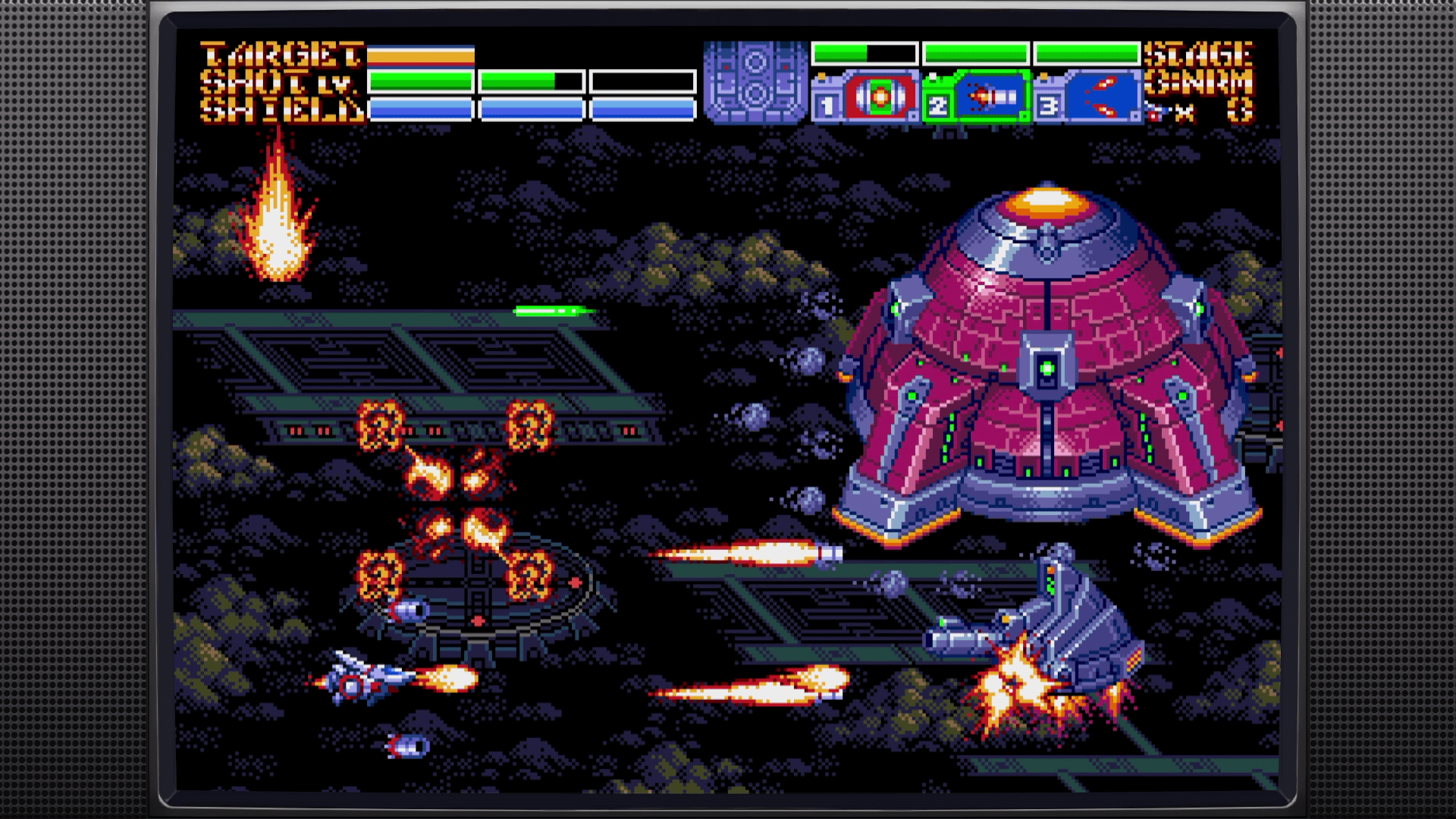
Earthion looks and plays like any traditional side-scrolling sh’mup like R-Type, Gradius, and Metal Black. You control a small little ship, YK-IIA, constantly flying to the right, dodging bullets and lasers, upgrade your weapons with power-ups, and destroy massive bosses whose bodies exceed the boundaries of the screen. As one who grew up with this type of game, Earthion feels like a blast from the past.
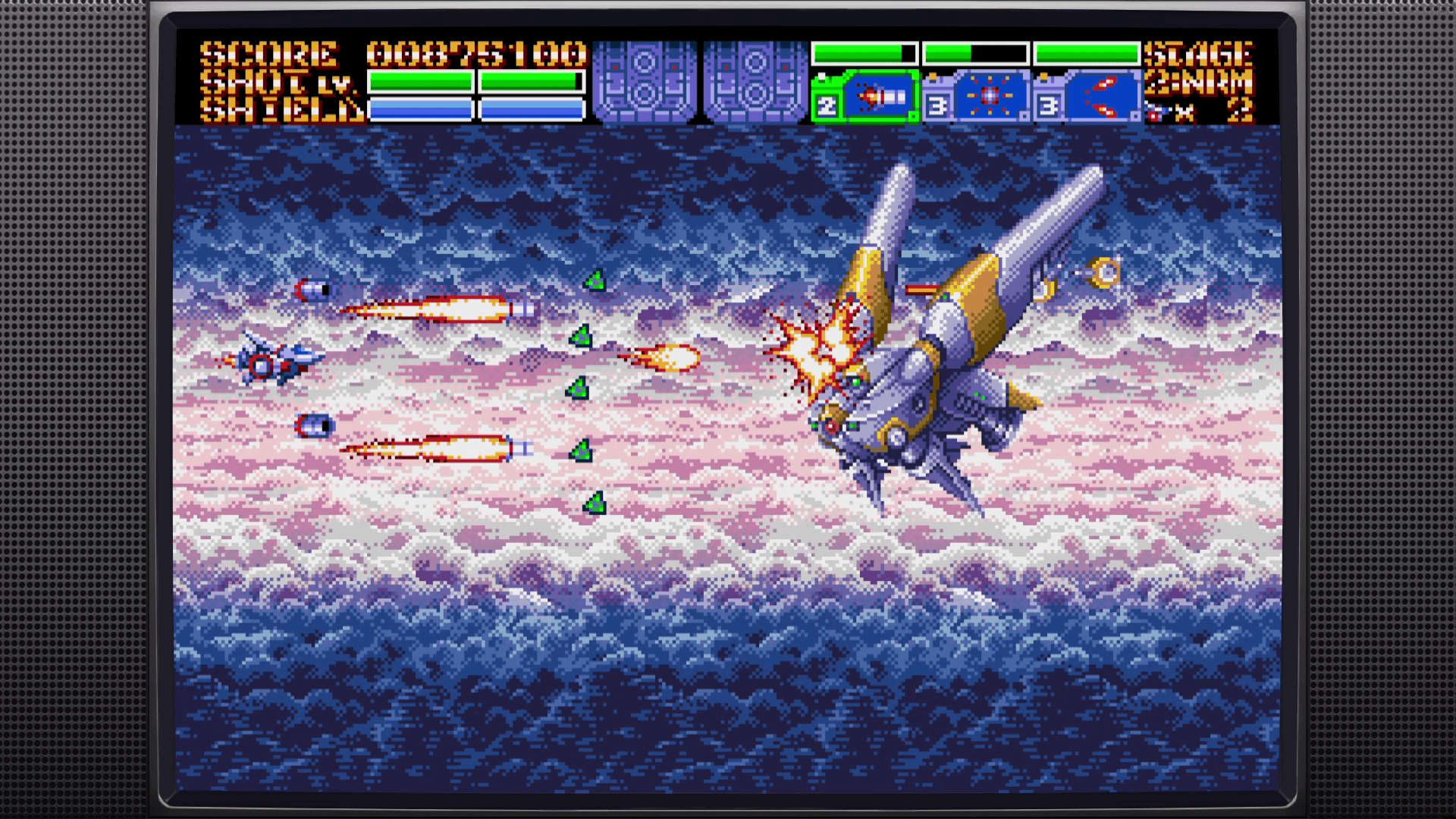 There’s a catch, however, that makes Earthion far more approachable and potentially accessible than sh’mups of my childhood. My little ship has a rechargeable shield system that can withstand several hits before exploding into smithereens. Defeating enemies and debris recharges that shield, while collecting green pickups (Solrium) increase the power of my ship’s primary weapon and any sub-weapon I had come across during a level. In practice, the rechargeable shield game me some breathing room when my screen slowly but surely filled with explosions, debris, and enemy bullets.
Earthion remains challenging despite the rechargeable shield. My first few attempts were played on the “Normal” difficulty, and it wasn’t until the seventh level (out of eight) where I began to struggle and succumb to hazards and bosses. The “Easy” difficulty turned down the bullet density a smidge, but it was still enough to keep me on my toes until the credits rolled. Newcomers to the genre should consider starting on Easy mode just to get a handle of Earthion’s flow before testing themselves on any higher difficulty.
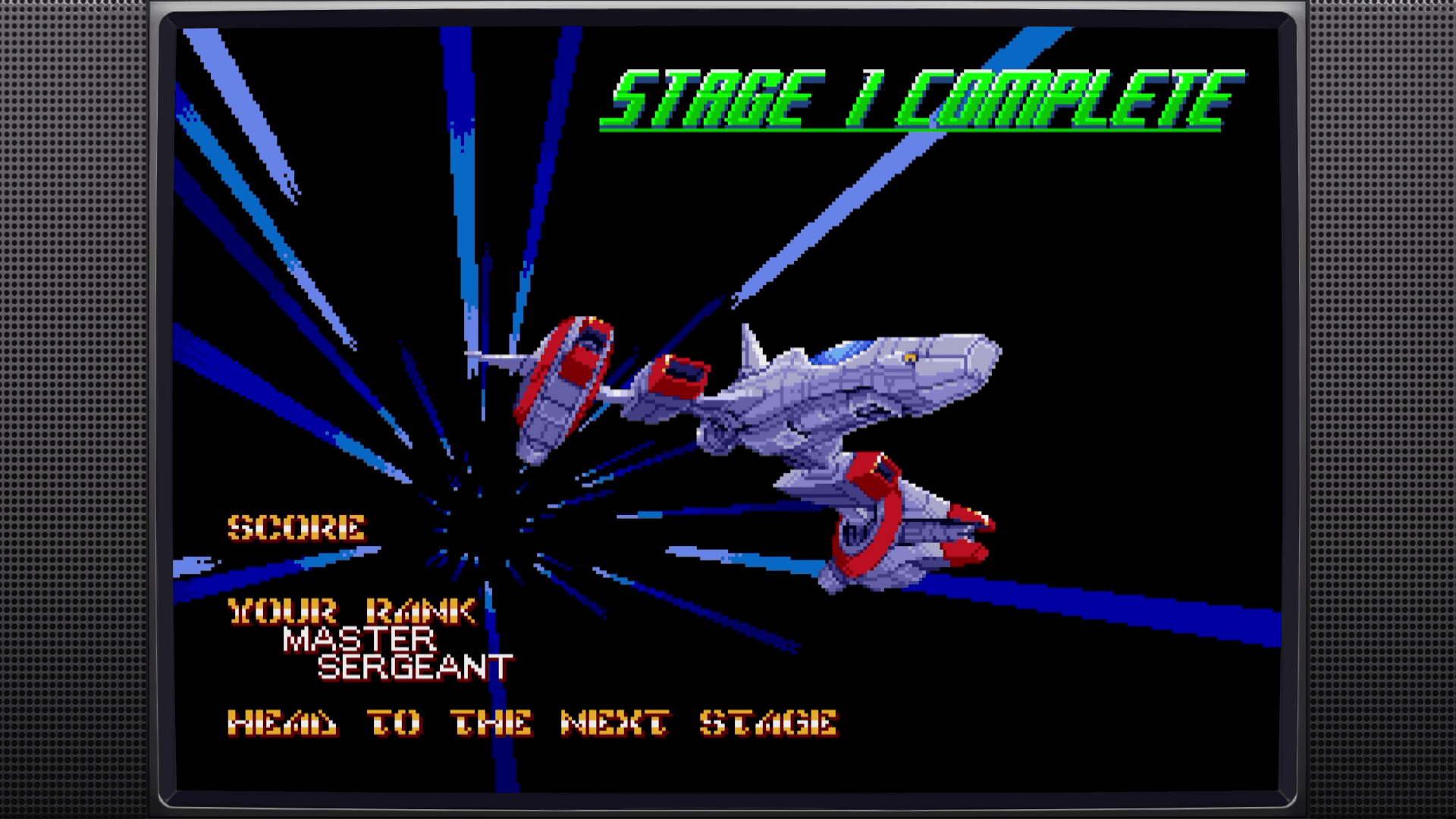
The other nuance exists in the form of permanent ship upgrades. At the start, the ship has a small shield and weapon strength with no subweapon. Subweapons randomly drop throughout the level, spanning lasers, large missiles, and curved beams. One specific subweapon, the “adaptation pod,” takes up a subweapon slot but offers no offensive bonus until I finished the level. Finishing a level with an adaptation pod gave me the opportunity to increase my shield capacity, increase the maximum level of my weapons, and more. The implementation of adaptation pods is especially smart in that it encouraged me to think critically about how I wanted to upgrade my ship going forward. Did I want to play defensively and upgrade my shields, or did I want to increase my weapon slots to let me freely swap between more weapons as the game went on?
 It’s becoming increasingly rare for sh’mups to make their way to modern consoles and present-day gamers, and it’s even rarer for sh’mups to innovate in a way that is approachable to newer players while giving genre veterans like myself a challenge beyond one-hit deaths, endless waves of bullets, and high-score chasing. Earthion does all of these things with ease, and it hooked me just as quickly as R-Type did back when I was a kid.
On the weapons front, I appreciate the variety of weapons available but some of them felt far weaker than others. I preferred the laser beam because of how it could pass through enemies, clearing them in single waves. Likewise for the Detonator, a weapon that fired bullets perpendicular to my ship and could clear enemies that were glued to the edges of the screen. Perhaps some balance changes could come in the future to increase the power and/or utility of some of the other weapons, such as the Blast Array or the V-Fire.
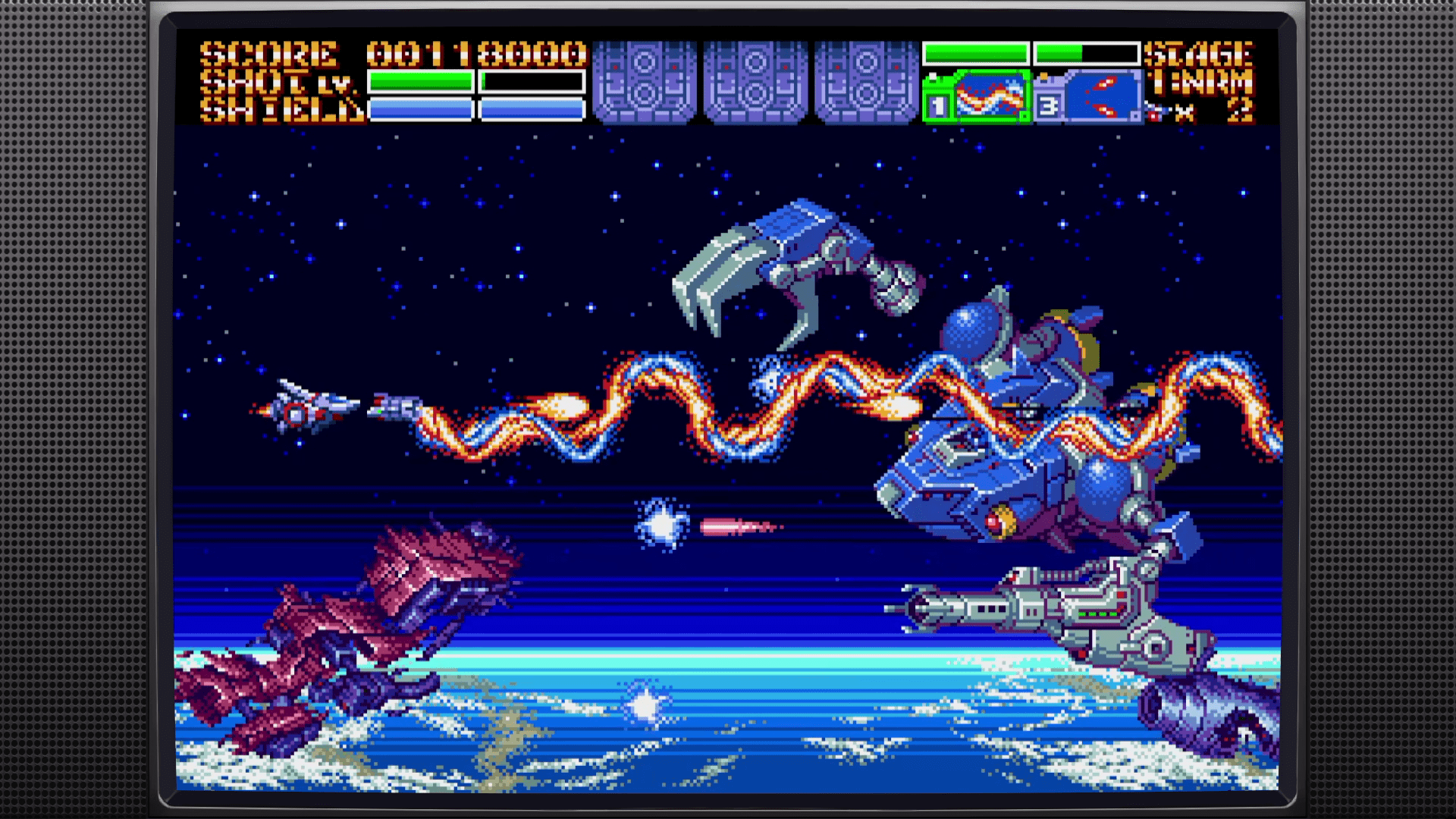 The spritework is impressive, with beautifully drawn environments and enemies alike. The SEGA Genesis may be limited in its graphical prowess, but Ancient has done wonders with pushing the envelope in designing beautiful sprites within the confines of the Genesis’ restrictions. The only real issue with the spritework is some of the environments in the last few levels; I struggled with discerning hazards and took damage because I kept flying into hazardous walls that I thought were part of the level’s background.
I’m curious to see how Earthion performs on the SEGA Genesis next year. The CRT filter that is natively reproduced by Earthion’s in-game emulator is crisp yet authentic. It looks too pretty and detailed to be a Genesis game I grew up with, but then again it could be that I’m playing on a 4K monitor and not sitting inches away from an old-school television with a CRT screen.
The standout element of Earthion is its soundtrack, many thanks to Yuzo Koshiro’s ear for recreating the synth-heavy soundstage that’s equally blood-pumping as it is catchy. The few modern-sounding soundbites kept reminding me that I was playing a modern title instead of a classic Genesis game, but everything else was perfectly represented in a Genesis-esque time-capsule that brought back all of the good nostalgia feelings.
If you’re concerned about replayability, don’t be. Earthion has quite a bit of things to do outside of the typical high-score chasing of the normal mode. Should you complete the game (or get a game over), you’ll be presented with a little passcode that can be used to carry your progress over to a new run with your prior weapons and upgrades. This is especially useful if you want to get a head start on a run on a higher difficulty. There are a handful of time-trial challenges, too.
 I was able to complete all of the challenges and a few runs in their entirety in just under three hours. I would imagine that a sh’mup veteran will have little issue doing the same in the same timespan. That said, there’s quite a bit of replayability that can, and will, keep me engaged for quite a few more hours. I plan on keeping Earthion installed on my main PC, as its arcade gameplay loop is short enough to satisfy a quick gaming break without becoming boring or requiring relearning the basic concepts.
Earthion is a perfect encapsulation of the timelessness of the SEGA Genesis. Ancient and Yuzo Koshiro have set the gold standard on how to breathe life into a shoot-em-up while innovating its reach to be fun for all players. Despite it being a Genesis title emulated on PC, it’s a must-have for anyone who loves retro games with just the right amount of challenge.