

Dragon Quest Heroes: Torneko’s Mystery Dungeon Classic HD is every bit a remastered version of a Japan-exclusive Super Famicom game from 1993. While it may be a white whale that inspired a genre, it does feel somewhat ancient and in need of a few updates.
Dragon Quest Heroes: Torneko’s Mystery Dungeon Classic HD is an engaging time capsule.
What more could you really ask of a Super Famicom Japan-only release from 1993?
Game preservation shouldn’t have to be such an agonizing experiment. There shouldn’t be so many lead walls in the path towards allowing audiences the opportunity to play games. Who does it benefit to have these pieces of entertainment and art marooned on physical copies and consoles that are horrendously unobtainable and unaffordable? Programmers’, composers’, and artists’ hard work is almost lost to time unless a person is able to emulate or pirate in an efficient way.
Why not release Torneko’s Great Adventure: Mystery Dungeon into the wild for modern-day audiences? After all, it is the first spin-off game in the Dragon Quest franchise and inspired a long line of Mystery Dungeon titles which includes the likes of Pokemon and Final Fantasy. Did Chunsoft know they were creating such a legend all those years ago?
I’m not going to pretend like I have any knowledge of Torneko’s Great Adventure or even the Mystery Dungeon series. Heck, the only Dragon Quest game I’ve played is Dragon Quest VIII: Journey of the Cursed King on PlayStation 2 and I mostly bought that so I could play a very early demo for Final Fantasy XII. But I know roguelikes and in this game I can absolutely see the inspiration that has rippled throughout the decades. From the progenitor that was Rogue to the hordes of roguelites and roguelikes we get every month, it’s inspiring to see a game from 1993 capture what so many now seek to do.
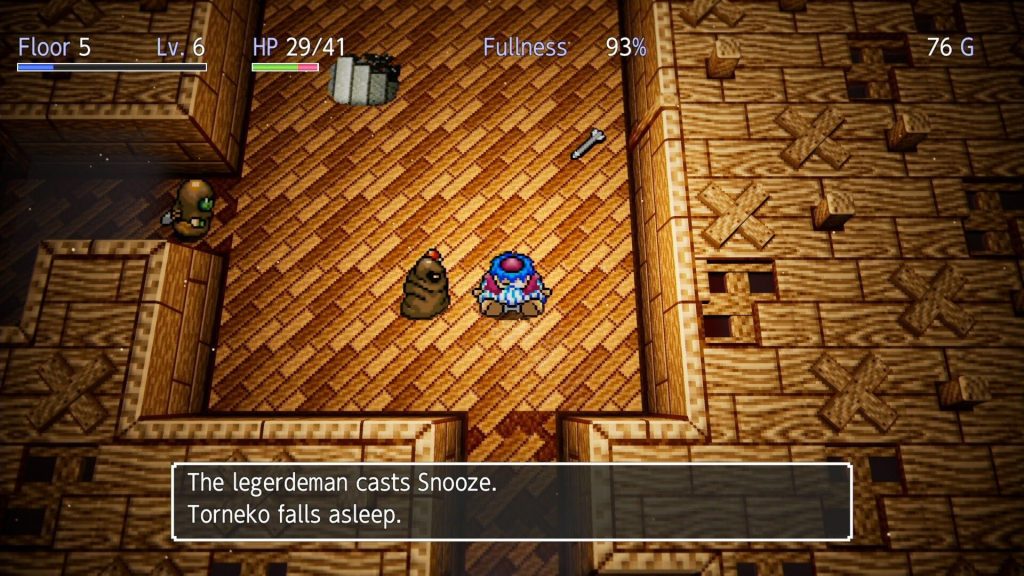
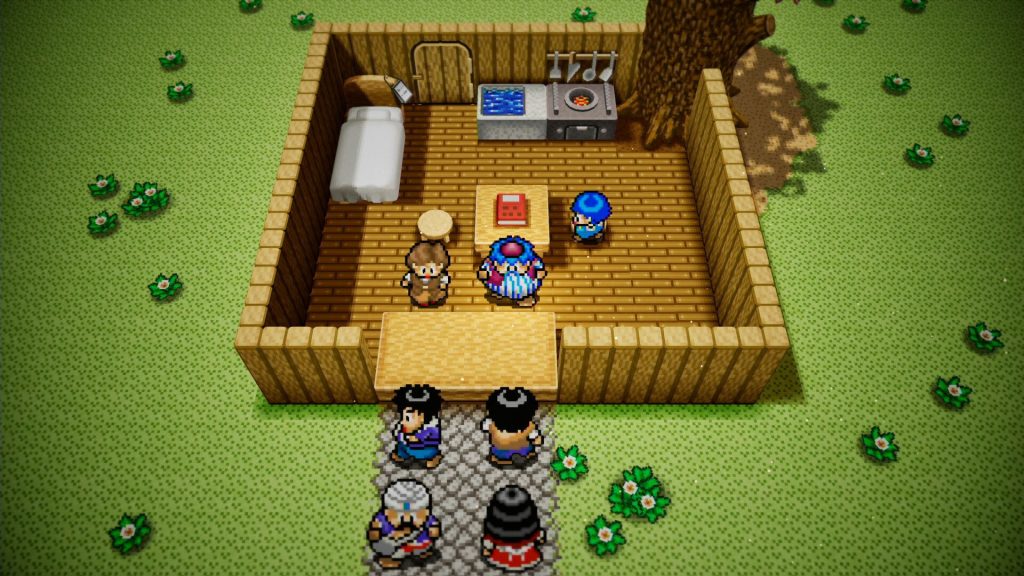
Torneko’s Great Adventure lacks much of a story. The merchant from Dragon Quest IV is now trying to make the greatest shop of all time, providing a life for his wife and son. Naturally there is a fabled treasure tucked away deep inside the “Mystery Dungeon” but to explore it, Torneko needs permission from the king. After proving himself in a “Small Mystery Dungeon”, Torneko begins his adventure into an ever-changing delve packed with monsters and riches. Don’t expect much outside of the bare minimum here. Players will get a glimpse into Torneko’s home life and the slow growth of his business, usually spurned by the successes and failures resulting from exploration in the Mystery Dungeon.
What is fascinating about Torneko’s Great Adventure is that for a game released in 1993, it represents so much of what many players experience in the modern gaming space.
The Mystery Dungeon is emblematic of the randomized runs that are so common throughout the countless roguelikes, becoming a mainstay genre over the last few generations. From The Binding of Isaac to Hades to Dead Cells. To spin-off genres housing the likes of Vampire Survivors. Random encounters and randomly generated worlds are becoming mainstays in snatching players’ attention and never letting go.
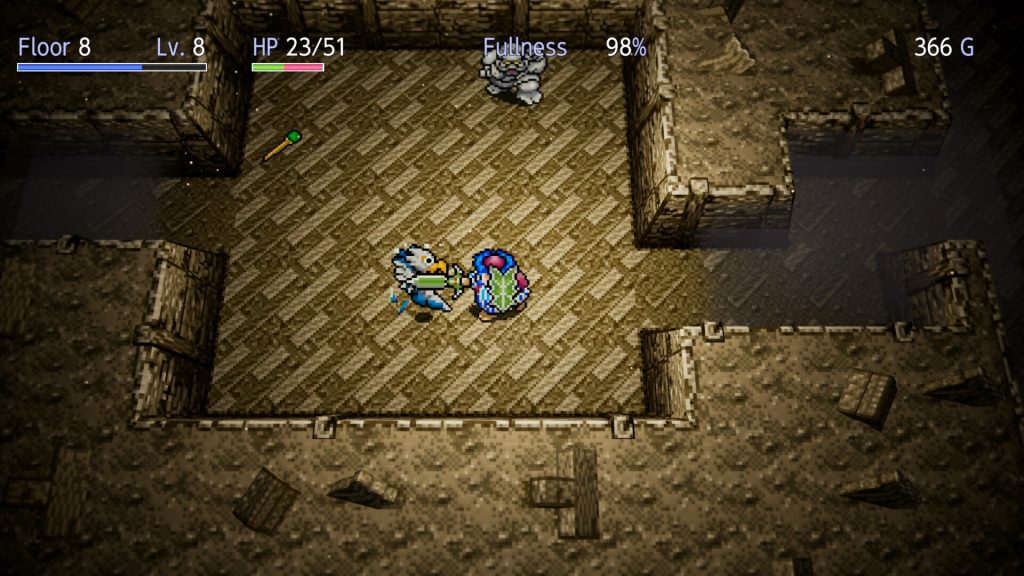
So, despite being a 33-year-old game, Torneko’s Great Adventure feels shockingly prescient for the time it was released and with the limited technology of the Super Famicom. Luck can often be a massive driving factor behind success and also frustration. At times players may find swords and shields early on, helping them have an advantage over weaker enemies and building up resources. Other times, they can be put to sleep on Floor 4 and whacked by an enemy until all HP is lost.
That unknown brutality can be quite intoxicating for players who thrive on not only challenge but min/maxing chance. It should come as no surprise that I found joy in overcoming a desperate moment and complete anger when what felt like a sure thing turned pear-shaped. That’s what a game like Torneko’s Great Adventure was built on.
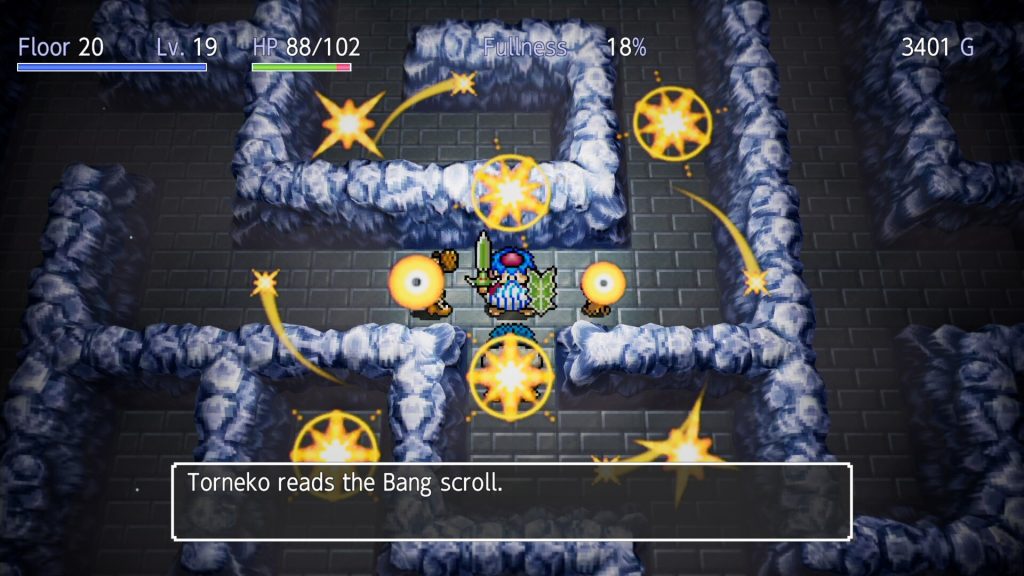
The turn-based RPG roots and the need to figure out unknown factors also plays a massive part in the game. When Torneko moves through the Mystery Dungeon, every enemy also takes a step. The playable space acts as a map of tiles with movement similar to a tactics game. Combat takes place in the moment when Torneko and an enemy come face to face. Attacks can be done in eight directions but the process requires a bit of a soft hand. A swipe of a sword, consuming an item, or casting a spell acts as a move that Torneko performs. Every other enemy in the dungeon will move in kind, even the ones not seen.
Slap an enemy with a sword and they will hit back. Meanwhile, that slime a couple tiles away also inches closer. Precision and thinking a few steps ahead becomes a crucial part of combat and navigation. Players can absolutely run away from an enemy if they are a couple tiles ahead but running into another foe may ruin the escape.
However, it took a good amount of trial and error to not spam attacks and movement. Numerous times I would just attack an enemy until it was dead, often hitting a couple extra attack inputs–which counted as moves–therefore allowing enemies to hone in on my position and get in a strike. This even happened when running around the map, accidentally pushing a button and having it count as an action. This old-school methodology intrinsic to Torneko’s Great Adventure is part of the experience and the challenge. For modern players it might not feel the best, though.
Other aspects of the game like having to analyze magic staffs and scrolls or consuming herbs before understanding what their purpose is aren’t unfamiliar to me. In games asking for a harder bit of role-playing, these mechanics are often welcome and can result in humor and education. While it might be frustrating when tied with harder difficulties, it’s important to recognize what kind of game this is, especially in the time it was released.
Dragon Quest Heroes: Torneko’s Mystery Dungeon Classic HD is, more or less, a way to play this old and not easy to play game on current consoles with a high-definition paint. A few difficulty options and sliders make the game a bit more palatable. Everything has a nice semi-isometric viewpoint. But this game is still going to crush the spirit at times.
Inventory space is extremely brutal until Torneko survives some trips and brings back gold. While this isn’t a game like Moonlighter by any means, there is a sense of growth that the player can achieve to make future runs more manageable. Yet I imagine a few training wheels that may have made the experience easier to jump into. Maybe an option to not have to climb back up every floor would have been nice. Or one that automatically revealed what every item and piece of equipment did.
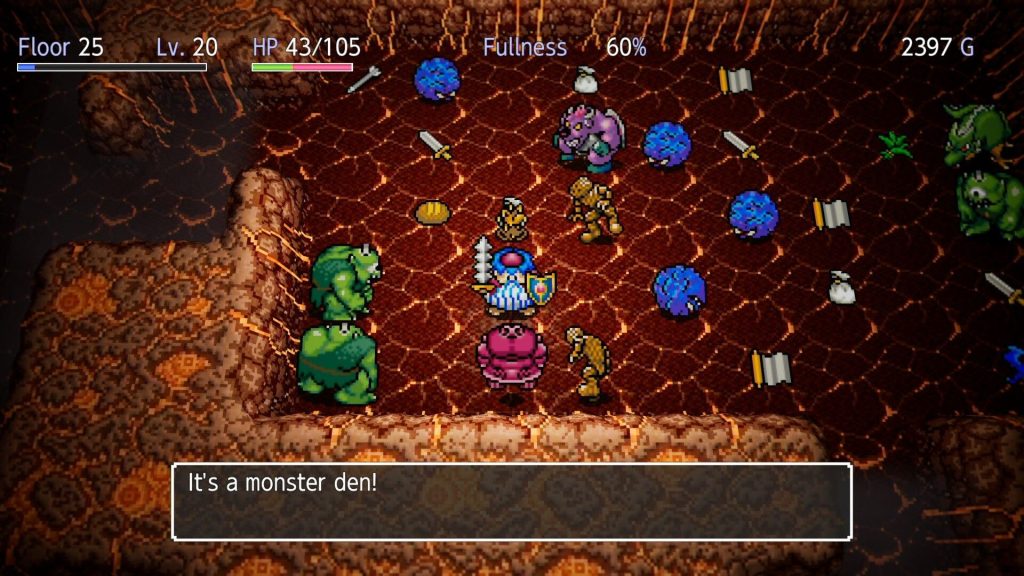
One of my biggest complaints was the game’s text scroll. I’m not sure what the issue is but there was a noticeable delay between text appearing from any action performed. It created a sense of lag between attacks and movement, causing me to make extra and undesired inputs. It’s a strange flaw in a game that shouldn’t be so demanding, making me wonder how simple of a fix it will be.
When trying to process Dragon Quest Heroes: Torneko’s Mystery Dungeon Classic HD in the context of a modern-day audience, I wonder what number of accessibility options would work in its favor. To me, this feels like an extremely specific need for a very specific player base: those who are massive fans of Dragon Quest, those who have an attachment to the original, or those who appreciate curios of the past that reflect current gaming trends. And do these people want a lot of modern flair? It’s possible, certainly. But I think it’s also okay for the game to exist like this, with enough polish that it doesn’t become lost to time.
Dragon Quest Heroes: Torneko’s Mystery Dungeon Classic HD is every bit a remastered version of a Japan-exclusive Super Famicom game from 1993. While it may be a white whale that inspired a genre, it does feel somewhat ancient and in need of a few updates.