
Capcom Fighting Collection 2 is another feather in Capcom's cap as it works to revitalize marooned games in its catalog. Though distinctly for genre enthusiasts, the high-quality netcode ensures that decades-old titles could have their time in the competitive scene.
Capcom is synonymous with fighting games. Street Fighter has cemented itself as one of gaming’s greats, matched in staying power and fame only by Mortal Kombat. And while Tekken and Virtua Fighter and King of Fighters and other mainstays have evolved over time, Capcom has created a definitive legacy.
In the decades since the games available in Capcom Fighting Collection 2 released, preservation has been a constant battle. Regardless of a game’s quality, it shouldn’t be marooned on an inaccessible island. Emulation has long been the solution to navigate the rocky waters of availability and ruthless prices but it shouldn’t be this way for people merely wanting to play, not collect.
Two collections have already been released by Capcom in its noble attempt at bringing older titles to the modern era. The original Capcom Fighting Collection offered 10 games, front-loaded by numerous Darkstalkers games. Marvel vs. Capcom Collection was wish fulfillment for anyone wanting that unexpected crossover.
Capcom Fighting Collection 2 has its sights set on arcade releases, especially those which saw the Sega Dreamcast as their only console home. Knowing the legacy of the Dreamcast–and the fact that I always wanted one–it wouldn’t be a surprise if the Collection is the first time a number of players have heard of these games, because I know it was mine. But what stuck out to me when playing a few of the entries in this Collection were the 3D fighters breaking through the boundaries of limited cartridge space.
For reference, the Capcom Fighting Collection 2 introduces the following eight titles:
- Capcom vs. SNK: Millennium Fight 2000 Pro
- Capcom vs. SNK 2: Mark of the Millennium 2001
- Capcom Fighting Evolution
- Street Fighter Alpha 3 Upper
- Power Stone
- Power Stone 2
- Project Justice
- Plasma Sword: Nightmare of Bilstein
Starting with Plasma Sword: Nightmare of Bilstein in 1998 all the way to 2004’s Capcom Fighting Evolution, there is a distinct vibe of the era embedded in the Collection‘s eight games. The 2D fighters are grounded in their roots but have taken on a bit of flash that wouldn’t break a console in the translation from arcade cabinet. The 3D fighters are a bit chunky and packed with big polygons but try to take advantage of a fuller range of motion.
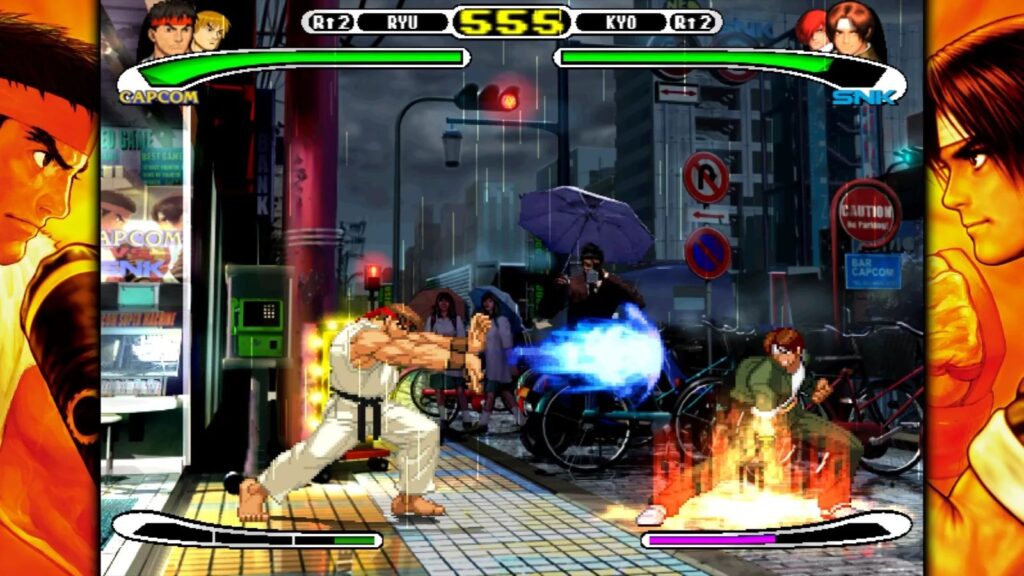
Capcom vs. SNK: Millenium Fight 2000 Pro and its sequel, Capcom vs. SNK 2: Mark of the Millennium 2001, are the Collection‘s 2D fighter highlights. It’s here that players can pick between a roster of Capcom and SNK fighters to craft unique teams and borrow fighting styles from the two developer’s catalog.
Implementing a 4-button layout from SNK games and forgoing the slightly higher complexity of Capcom’s 6-button moveset, both Capcom vs. SNK titles strives to blend the two distinct moods into cohesive experiences. Notably, this is done with the “Groove” system that allows players to use that ability and super moveset of their preferred fighter series. In 2001 Pro, this is done with the Capcom Groove and the SNK Groove, where the former builds meter with attacks and the latter focuses on charging up. That same logic applies to Millennium 2001, where the C-, A-, P-, S-, N-, K-Grooves can be selected for increased diversity.
What further sets the Capcom vs. SNK games apart is providing players with the ability to craft a team of fighters using a “ratio” system. Any character on the roster is assigned a ratio number of 1 to 4 and a team’s composition caps out at 4. This introduces a wealth of customization. Four 1-ratio fighters? A single 4-ratio brawler? Capcom vs. SNK‘s engagement stems from juggling the Groove and Ration systems, allowing player to craft teams not only from their favorite fighters, but from alternate styles and formulas.
Released in 2000 and 2001, the Capcom vs. SNK games reek with “turn of the millennium” flash Entrenched in the culture of a world coming into Y2K, it’s strikingly similar to the transition from the 80s and 90s. An emphasis on CGI is noticed immediately on booting up 2000 Pro, being greeted by trance beats and dizzying visuals.
Street Fighter 3 Alpha Upper is one of the numerous versions of the game bridging that gap until Street Fighter 4 fully altered the franchise’s look. Having never played a single version of Street Fighter 3, I can’t speak to the prominence of Alpha Upper. It includes balance changes from previous version, especially a crouch-cancel that fans likely have taken advantage of in the past. In terms of what Alpha Upper brings to the Collection… well, it’s a Street Fighter game and it almost would feel wrong not to include some version of the series.
Rounding out the 2D fighters is Capcom Fighting Evolution. Unlike Capcom vs. SNK, Evolution is all Capcom fighters, meaning a massive roster to pick from. Because my experience with Capcom 2D fighters was limited to Street Fighter 2 on the SNES, the idiosyncrasies with Evolution aren’t necessarily as prominent for me as they were to more experienced players and critics back when the game first launched. Fighters’ styles, attacks, and everything are pulled directly from the specific game they appeared in, whether that was from Street Fighter 2 or 3. Because of this, there isn’t a uniform fighting style and some characters may feel less comfortable to players based on their experience with the series. While I can’t say I didn’t like Evolution, its experimentation doesn’t feel as unique as the Capcom vs. SNK games, possibly making it one of the more niche games in the overall Collection.
Plasma Sword: Nightmare of Bilstein is the sequel to 1996’s Star Gladiator, Capcom’s first in-house 3D fighting game. Plasma Sword shows all the rough edges of a genre that was edging its way into uncharted territory. The game implements a number of conceits I recognize from other 3D fighters, including the ability to shift between planes, allowing players to sidestep attacks and have a sense of fighting in a circular arena. Additionally, Soul Caliber fans will enjoy Plasma Sword‘s heavy reliance on weapons.
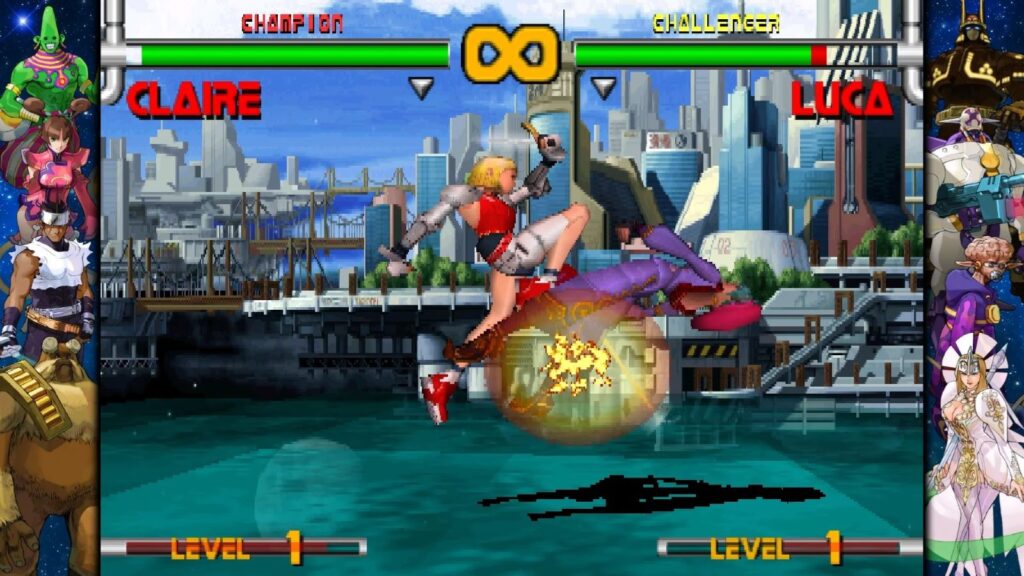
Despite a story that can be pieced together through numerous fights, I couldn’t help but be charmed by how absolutely weird the roster of fighters in Plasma Sword is. All manner of humans, aliens, and strange creatures will engage in one-on-one combat, with a number of these characters acting as palette swaps with a few different moves.
Using a four-button layout, two buttons control weapon attacks, one button for kick attacks, and another button for sidesteps. Like other Capcom fighting games, a “Plasma” meter builds up over time, dictating the kind of special moves a player can use. Players can also consume their gauge to counter an enemy attack with a Plasma Reflect, making combat a touch more interesting than whacking each other with weapons.
Project Justice is the second 3D fighter incorporated into the Collection and I found it to be as equally quirky as Plasma Sword. Unlike a 1v1 fighter focused on weapons, Project Justice has a 3v3 team composition and uses high school archetypes, making it exceptionally charming, especially for the era it debuted in. Project Justice is more focused than Plasma Sword not only because of its grounded setting but likely because Capcom had a few years on 3D tech to improve hit detection and visuals. The ability to swap teammates and use synergy moves is a characteristic spread across the Collection‘s best entrants.
Plasma Sword and Project Justice felt more my speed when I was messing around matches and not actively trying to be that good. The games may not be the marquee titles here but still deserve their place in the vast library of fighters.
Power Stone and Power Stone 2‘s reputation preceded their inclusion on the Capcom Fighting Collection 2. I’ll admit to having heard the name “Power Stone” numerous times over my life but, until recently, simply had no idea what the games were about.
Power Stone is going to be most noteworthy for paving the way for its sequel. As it stands, Power Stone is a chaotic 1v1 brawler that isn’t as precise as the other fighters in the Collection. The enemy AI is extremely punishing and often it is hard to know what’s going on when trying to make a mad rush for an item or weapon that can turn the tide of battle. Dabbling in Power Stone has its moments, especially when two friends are beating up on each other, but it pales in comparison to Power Stone 2.
I was immediately in love with Power Stone 2 and the inescapable feeling that I was playing some kind of alternate dimension Bizarro version of Super Smash Bros. Over the last 25 years I doubt I’m the only one who has had that revelation but the close proximity to each series’ release dates at least makes me feel like Capcom and Nintendo had the same brilliant spark at the same time.
Capable of allowing four players on screen at a time, Power Stone 2 is less a fighting game and more of a 3D brawler. Choosing from a list of over a dozen characters, players are dropped into a map and simply asked to pummel each other until only two remain. Some levels are seen from a slightly isometric angle that shifts as the level changes while others have the camera focused squarely on the field.
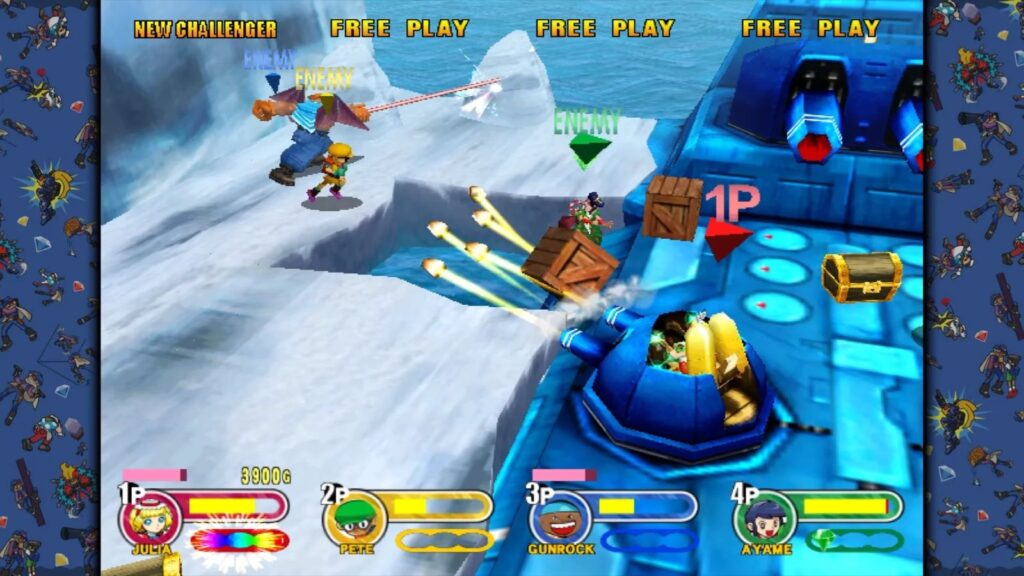
Unlike the other games I played, Power Stone 2‘s characters have an extremely simple moveset, consisting of a few basic attacks and a jump attack. But over time, each level gets peppered with items. Hammers, swords, guns, skateboards, healing items, and dozens of other things can be picked up and used against other players or the sparse enemies and bosses that are thrown at the player. Frequently, gems will pop up and when the player collects three, they morph into a special form that has different attacks and a devastating special move.
Power Stone 2 feels easily to conceptualize and, even in doing so, barely scratches the surface of why I found it to be so engaging. Action in the game is easy to follow but only hectic to the point of being illegible. But the stakes feel so wildly low that it’s hard not to picture four players standing at a cabinet just mashing buttons and goofing off. If I had a Dreamcast and was in college, this would have been the thing to play in the communal hall along with Smash Bros. Melee.
There is a distinct wacky aesthetic to its colorful, loud characters with their repeated quips. The shout of the announcer saying “Oh no!” when I would get whacked and lose my gems made me laugh every time. The reliance on picking up boxes and throwing them or scurrying to the nearest weapon meant that multiple people would make a mad dash and fight over whatever was closest.
Despite being mildly imprecise and floaty, those aspects don’t matter when it comes to the large health pools. Players go through a series of levels where they are intended to whittle down the health of everyone else, leaving two people standing. Two boss fight levels pit two players against insanely weird bosses, incorporating similar mechanics. Nothing surprised me more than to be able to hop on top of the first boss, climb into his turret, and blast off half his health. And what keeps Power Stone 2 fresh is the way each level changes as time goes on. My first Power Stone 2 experience had me fighting on two boats racing through the ocean. Occasionally the screen would tell everyone to move to a different boat while one sank. Eventually, one boat crashed into a glacier, transitioning players to two different surfaces. A later level had us fighting on a series of moving platforms and elevators, the level constantly shifting upwards.
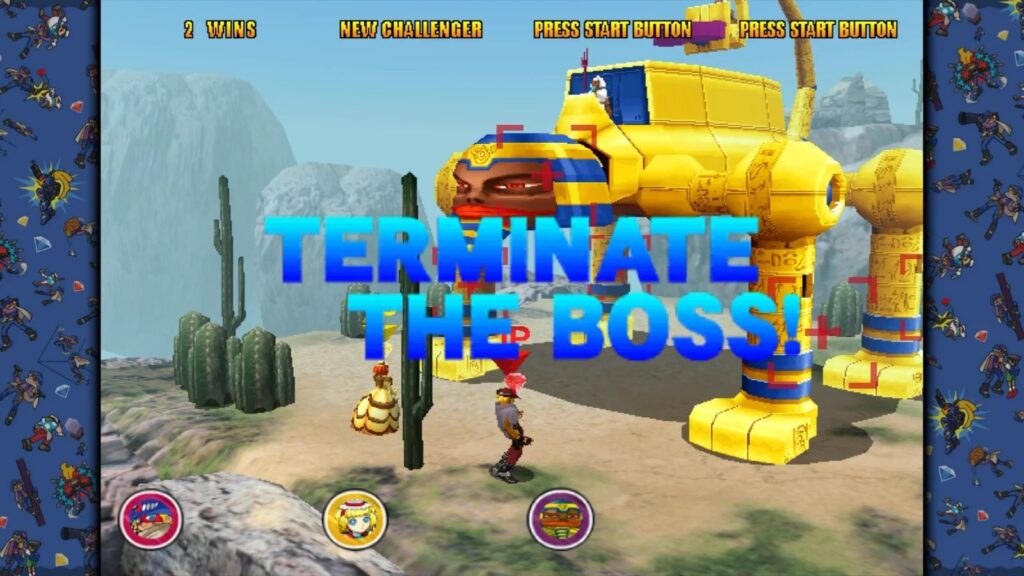
Instructions are always clear but that doesn’t mean it’s easy to find stable footing when multiple players are vying for space. Gracefully, minimum damage is taken when getting left behind, ensuring that the chaos isn’t too punishing. I played through two complete sessions of Power Stone 2, each with multiple characters and choosing different paths to reach the end. And honestly, I think the game may be the highlight of the Collection. Where most will instinctually understand the nature of the 2D and 3D fighting games, Power Stone 2 is so inherently different that it could potentially be worth the price of admission.
Across the Collection, the numerous improvements and bonuses present are a wonderful boon to the overall product. 2D fighting games have a Training mode where players can dive in and measure out hitboxes with visual aids, see damage numbers, and map out inputs. Marquee cards are available for all eight titles that show off how the controls were displayed on the arcade cabinets. Visual filters and alternate music tracks are also available.
But the biggest gold star to the Collection is the phenomenal rollback netcode meant to benefit online play of any caliber. Of course there is a wealth of charm in looking back on those days grouped around the arcade cabinets. But allowing players across the world the ability to match with each other to test their skills will breathe new life into these old games. And for those players who merely want to dip their toes into another time, difficulty rankings and the ability to tie specials to a single button press feel like an added dose of accessibility for those whose reflexes aren’t as good as they were 25 years ago.
Players may wish for in-depth instructions for every game but the included material does offer enough for fighting game veterans to brush off any rust they may have. Visually, the eight games feel as accurately replicated as they can, matching pixels and polygons in a way that doesn’t make them feel washed out or stretched.
Capcom Fighting Collection 2 is another feather in Capcom’s cap as it works to revitalize marooned games in its catalog. Though distinctly for genre enthusiasts, the high-quality netcode ensures that decades-old titles could have their time in the competitive scene. While Capcom may soon run out of quality material to include in these offerings, one can only hope different genres (and prominent publishers) will follow suit.