

I know a lot of younger gamers who are going to enjoy the heck out of this. And a few college students I teach as well. And probably some adults (me).
Anyway! Bluey’s Quest for the Gold Pen from developer Halfbrick Studios Pty Ltd heads to consoles this month, and sometime ‘coming soon’ to PC as well. It’s a simple game that features the voice actors from the television show. It’s playful, silly at times, and carries with it a perfect salute to the show’s brand and style. Is it challenging? Only a bit, but this isn’t meant to be Dark Souls, as the jumping puzzles, fun gimmicks, and wacky characters are a firm reminder of the audience that the game is trying to reach. As long as players know that this was built and designed for kids, no one can be disappointed with the results of the lighthearted gameplay execution.
Bluey’s Quest for the Gold Pen is a simple game that is driven by an adorable narrative fit for the show. The game is ignited through the tomfoolery of Bluey’s dad, who steals Bluey’s gold pen, thus preventing her from finishing her drawing. Bluey and Bingo (Bingoose) must go after the thief in a set of make-believe worlds, traverse land, sea, and air, until the quest to re-obtain the gold pen is finished.
While the narrative is worthy of the television show it sprang from within, it’s an easy story to follow and does a great job of complementing Bluey’s gameplay built for it. As one would imagine, the lands that Bluey and crew travel through are generally ridiculous and filled with whack-a-doodle creatures that generally pose more humor than threat to Bluey’s perceived plight. In short, the narrative permits the developers to go as far as they want with the game, and they do their best to make it an accessible adventure from said narrative that best represents the show most kids know and love. In other words, it’s a means to an end, but a good means.
As for the gameplay, it’s remarkably intuitive to pick up, and not so challenging that it will cause frustration for a younger audience. The combined gameplay elements make for an entertaining and lighthearted adventure. For a game like Bluey’s Quest for the Gold Pen, that is all you can really ask for from it.
The challenge of the game starts with exploration, with the driving point being finding objects, mainly lost workers/friends, beads, and goose food. From map to map, Bluey will explore large landscapes that vary in style and purpose. Some of those landscapes are water-based, some are desert, and others are snowy terrain. What Bluey finds on each map is dictated by the personality that each map adopts. Of course, that is mainly for show because underneath those weather-driven personalities lies the same type of gameplay structure from place to place. For example, Bluey will always be on the hunt for beads, which are embedded in plants scattered across each map. Once Bluey touches one of these plants, she gains a bead, which, if enough are gathered, can be used to exchange with a gnome for goose food.
Now, goose food is a second repetitive construct of each map. This is the main item that Bluey must find in order to progress to the next map. If Bluey finds and feeds Bingo (dressed like a goose) enough food, then Bingo will lay an egg, which hatches an item that is given to a guardian who allows the pair to pass to the next map. It’s incredibly easy to find and gather this food, with the only big difference, outside of the occasional varying puzzle, being the guardian of the portal gate. The humor that results from getting that gate open is also amusing. But, ultimately, it’s all the same from map to map.
When Bluey isn’t on the hunt for goose food or beads, there are additional side quests that she can take on, which mainly involve finding lost creatures. For example, on the desert map, Bluey has to find lost worker ants that are secretly scattered across the map. If she does find them, then she can get them back to their friends and obtain a reward for it. It’s a side quest because the player doesn’t need to find these creatures to move to the next map. It’s simply there to give more reason to explore maps and to keep the gameplay interesting. The latter of which is incredibly vital for this game to engage and hook players.
While this all might sound boring and repetitive, that doesn’t mean it isn’t fun.
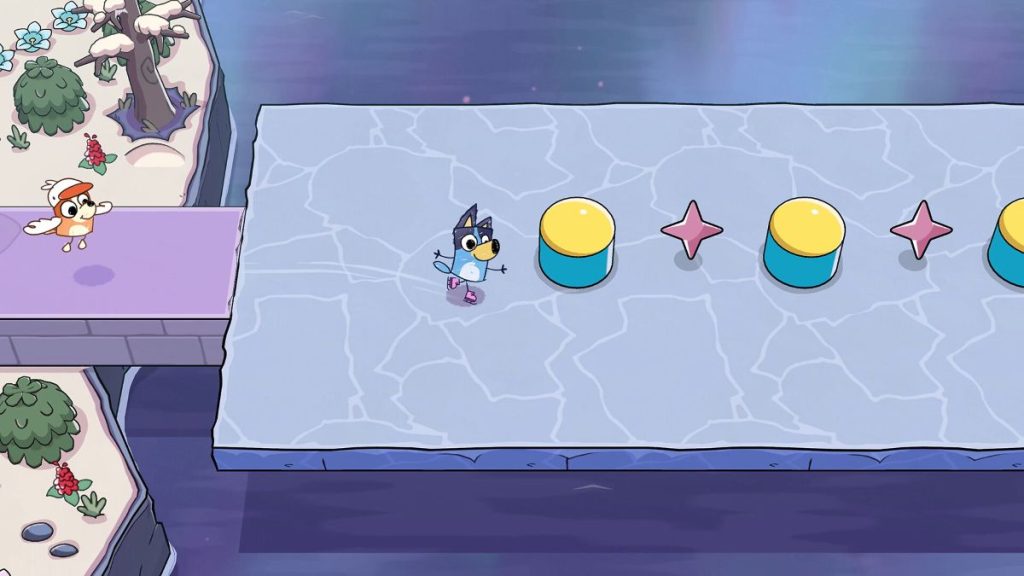
Since this is a game made for younger gamers, there are two hard and fast rules that need to be met to make it fun for that audience. The first one is that there are fun puzzles and semi-challenging jumping puzzles that motivate the younger player cognitively. These types of puzzle structures make the game constantly engaging for the younger player. Knowing that there will be more than just simple grab-and-go object-finding missions means that there is a bit of a challenge to the process, and thus a little bit different from puzzle to puzzle. For example, there might be a puzzle where Bluey has to hook onto stars quickly, pulling her from platform to platform, before each platform crumbles and disappears. While doing this, the goal is to obtain stars that lie between said platforms and get that star hooked quickly to obtain the next one. Time is a factor in this type of gameplay, as the stars have a time limit on their appearance, and the platforms could crumble, sending Bluey tumbling to the ground. Having both problems happening at once makes for a challenging venture for younger gamers, but not an impossible one. It’s easy enough to get through, but challenging enough to have to repeat.
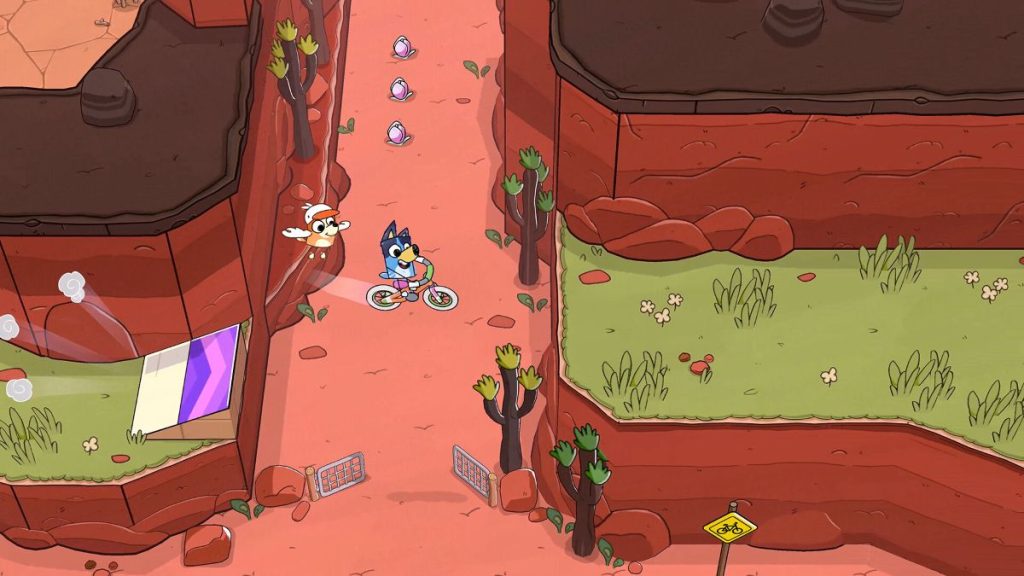
Another example of a varying puzzle is using Bluey’s wand (the weapon of choice that doesn’t hurt beings, just objects) to shoot large crystals/eggs that activate platforms for a short period of time. Aiming, shooting, and watching the time in order to cross the platforms can be stressful, but not frustrating. Much like every map, it’s a different puzzle dictated by the map it is on. There is one memorable puzzle, which is on the desert map, that has Bluey and Bingo riding in a minecart, jumping crevices, and collecting stars. One wrong move and they plunge towards the bottom of the shaft and must start over. While it might be the same jumping requirement, the scenario of using a minecart and changing perspective in the game to a platformer view makes it feel different enough to keep it fresh. In short, the game’s challenges are more than just a simple hide-and-seek scenario.
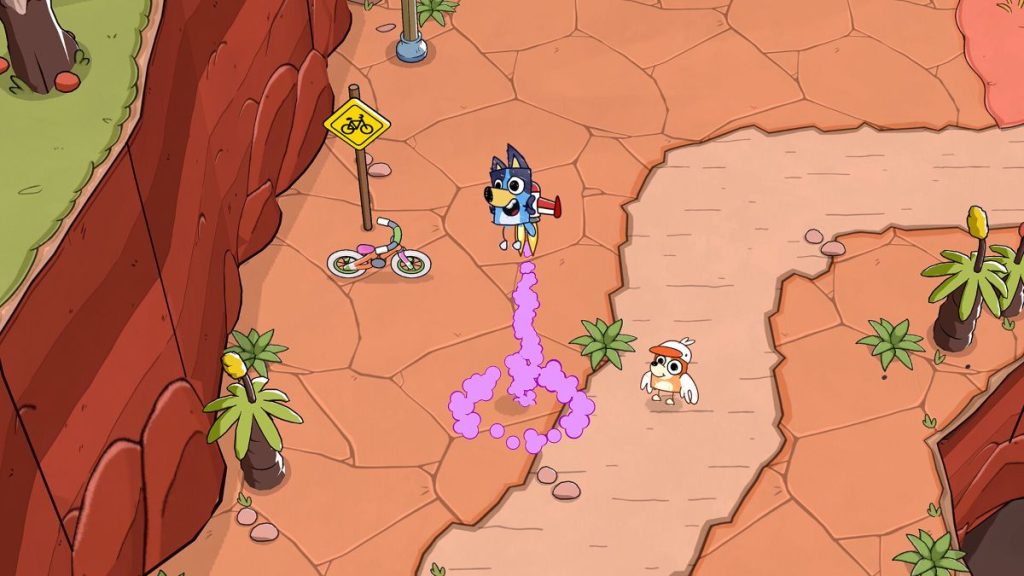
Mixed into that scenario, and the one element that truly adds more fun to the gameplay is the various methods with which to navigate the puzzles. For example, on one map, Bluey gains the power of temporary flight, which allows her to float across crevices for a short amount of time. While the goal is still the same, obtaining stars that lead to goose food, the manner in which it is done changes enough to make it feel new and interesting. That is essential when it comes to hooking a younger audience to enjoy gameplay. In this respect, Bluey’s Quest for the Gold Pen does a great job with those varying hooks.
The second hard and fast rule for making a successful game for younger players is to make everything consistent. This means that the player will know they have to find beads, collect goose food, and find some sort of insect, creature, or animal to collect. The only difference is how puzzles are executed, but the goals are the same. It will also mean seeing the same type of quest characters engaging the player in the same way throughout each land. For example, there is a quiz gnome that pops up somewhere on each map. They ask questions regarding the land Bluey is exploring and give the player a chance to win a goose food piece. Knowing that each map contains these items to collect, characters to run into, and is guaranteed to have unique puzzles that the player must think about to traverse means they’re fun and keep the gameplay a little bit more interesting.
Anyway, these two above rules are a necessity to keep players hooked into a game that is otherwise repetitive in its construct. The varying maps and the different puzzles, but consistent collection goals, help to make and keep the game fun, as well as lighthearted and slightly challenging. Bluey’s Quest for the Gold Pen contains some great gameplay that achieves both goals for a younger audience. Heck, even an older gamer like me enjoyed the time spent with this simple game. It was a relaxing rest stop between very complicated and brutal review experiences of other games. A reviewer can only take so much shooting in a game. Sheesh.
Ultimately, the gameplay is easy with exploration and object finding, and contains creative and well-constructed puzzles. It’s everything you would expect from a game geared toward younger gamers.
Before I wrap this review up, I have to give some major kudos for the cast lending their voices to the game, the art style, which is crazy cool, hand-drawn fun, and the overall feel of the experience. In this day and age, when some of us are looking for positivity in the world, games like Bluey’s Quest for the Gold Pen deliver it thanks to the above elements. It’s a great experience that doesn’t take itself seriously but delivers entertaining and familiar fun.
On that note, let’s wrap up this review.
Conclusion
Bluey’s Quest for the Gold Pen is a good game for younger gamers. It contains a familiar cast of characters, a positive and fun set of worlds to explore, and just enough challenge to make it interesting and engaging. This isn’t built for hardcore gamers, but it is built for gamers just getting into their gaming groove.